roundups
Best Footrests with Storage for Office Use (2026 Picks)
Footrests that double as under-desk storage. Wood box, padded ottoman, and bamboo picks compared for stability, comfort, and storage capacity.
 Daniel Osei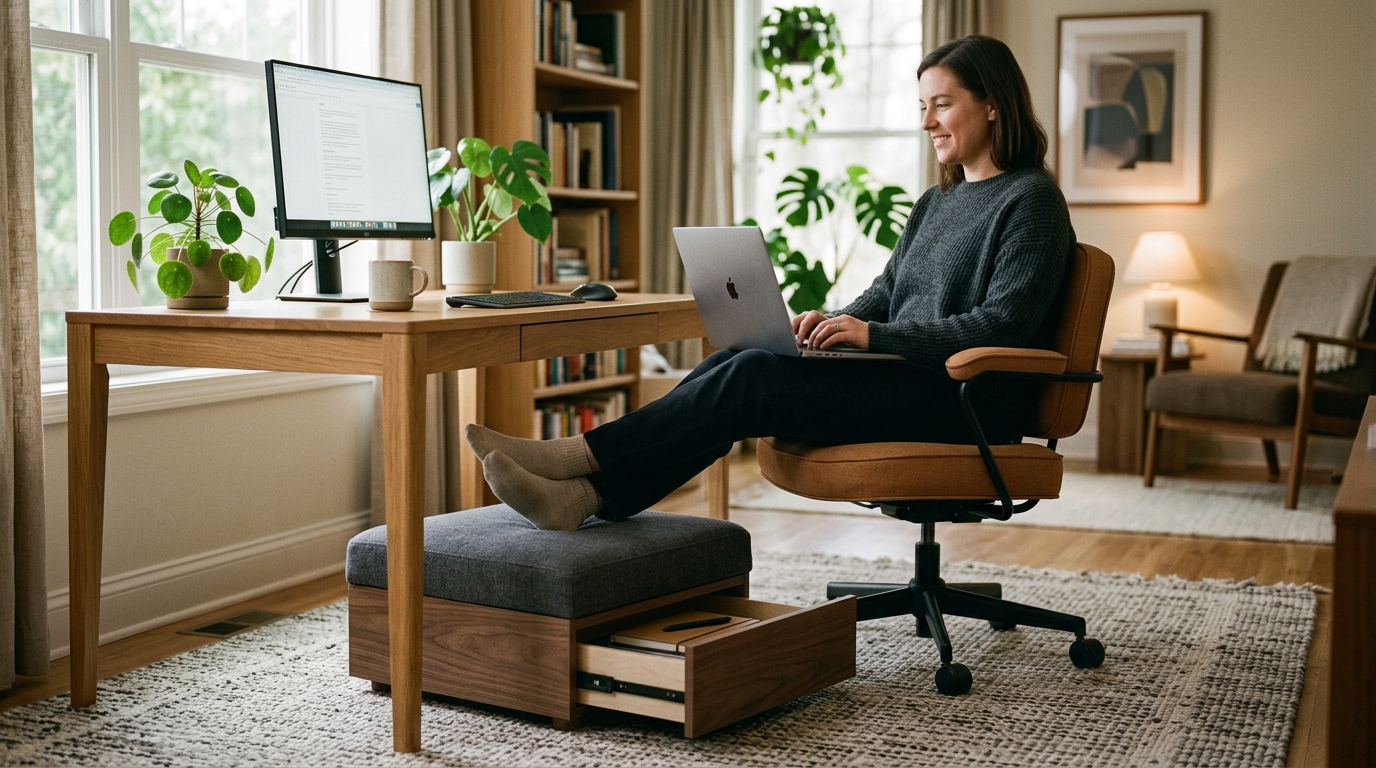
The best footrest with storage for most offices is a solid wood or bamboo box with a hinged lid at 4 to 5 inches of height. It elevates your feet to the right ergonomic angle while keeping chargers, notebooks, or cables hidden under your desk. For home offices where aesthetics matter, a padded cube ottoman with flip-top storage adds foot comfort without sacrificing the dual function.
Quick comparison
| Product | Best for | Rating | Notes | |
|---|---|---|---|---|
| Solid wood footrest with flip-top storage | best overall for most home offices | ★★★★★ | Height 4 to 5 inches. Hinged lid. Firm platform does not compress. | Check price |
| Bamboo footrest with storage compartment | eco-conscious buyers; lighter weight | ★★★★★ | Bamboo construction. Sliding or hinged lid. Typically 2 to 4 lb. | Check price |
| Cube ottoman with flip-top storage | home offices where cushioned surface matters | ★★★★☆ | Fabric or faux leather lid. Larger interior volume than wood box. | Check price |
| Compact under-desk storage footrest box | tight desk clearance; minimal lift needed | ★★★★☆ | Low-profile 3 to 4 inch height. Fits desks with limited apron clearance. | Check price |
The picks
Best overall — solid wood footrest with storage
Best for most home offices wanting dual-purpose ergonomic and storage function
Solid Wood Footrest with Flip-Top Storage Lid
A solid wood box footrest is the most stable option in this category. The platform sits firm and does not flex under foot pressure — unlike a padded ottoman, which compresses over time and lowers its effective height. The hinged lid lets you access stored items (charging cables, a notepad, a secondary charger) without pulling the unit out from under the desk. At 4 to 5 inches of platform height, it fits the foot-rest geometry for most users from 5 feet 2 inches to 5 feet 10 inches seated at a standard 29 to 30 inch desk. Hardwood versions last 5 to 10 years under daily use; bamboo versions are lighter but comparable in longevity.
★★★★★ 4.6 · 1,800 reviews
Check current price on Amazon→Pros
- Firm flat surface does not compress — the 4 to 5 inch height stays accurate over years
- Hinged lid is accessible without moving the footrest from under the desk
- Hardwood or bamboo construction handles years of daily foot pressure without failing
- Interior compartment holds chargers, cables, a notepad, or small office supplies
- Neutral wood grain blends with most desk finishes and office aesthetics
Cons
- Bare wood surface is less comfortable for extended barefoot or sock-foot use
- Fixed height — no adjustment if 4 to 5 inches does not fit your exact chair-desk geometry
- Internal compartment limited to smaller items; not suited for books or larger electronics
- Heavier than padded options at 4 to 8 lb depending on wood type
Best eco option — bamboo footrest with storage
Best for eco-conscious buyers wanting a lighter, sustainable storage footrest
Bamboo Footrest Box with Storage Compartment
Bamboo box footrests hit the same ergonomic geometry as hardwood at significantly lower weight — typically 2 to 4 lb versus 4 to 8 lb for hardwood. Bamboo compresses and wears comparably to soft hardwood in foot-rest applications, so the durability trade-off is minor. The lighter weight matters if you shift the footrest between a sit-height and stand-height desk position, or if you move it home from the office occasionally. Storage compartments on bamboo footrests use either a sliding panel or a hinged lid — verify the lid mechanism is stiff enough not to pop open on its own when you shift your feet during the day.
★★★★★ 4.5 · 980 reviews
Check current price on Amazon→Pros
- Lighter at 2 to 4 lb — easier to reposition when reconfiguring the workspace
- Bamboo grain finish reads clean in modern and Scandinavian-style offices
- Sustainable material compared to solid hardwood at a similar price point
- Storage compartment fits small office supplies, cables, and a charger
Cons
- Bamboo surface scratches more easily than hardwood under gritty shoe soles
- Sliding-lid mechanisms on cheaper bamboo models loosen after 1 to 2 years
- Less structural rigidity than oak or walnut at the same price point
Best padded option — cube ottoman with flip-top storage
Best for home offices where foot comfort matters more than precise ergonomic height
Cube Ottoman Footrest with Flip-Top Storage
A padded cube ottoman is the right pick when foot comfort is the priority over exact ergonomic height accuracy. The cushioned surface is far more comfortable for barefoot or sock-foot use during long sitting sessions than any wood or bamboo platform. The tradeoff is compression: the padded lid compresses 0.5 to 1 inch under sustained foot pressure, so the effective height you get is lower than the listed height. If you need a precise 5-inch elevation, a wood box is more reliable. The storage volume inside a cube ottoman is substantially larger than a wood box — often 5 to 10 liters — enough for a small laptop, a power bank, or a pair of spare shoes. Lid material is usually fabric or faux leather.
★★★★☆ 4.4 · 3,200 reviews
Check current price on Amazon→Best compact — low-profile under-desk storage footrest
Best for desks with tight floor-to-apron clearance or users needing only a small lift
Compact Under-Desk Storage Footrest Box
When desk clearance is tight — older fixed-height desks often have only 24 to 26 inches of floor-to-apron space — a compact storage footrest at 3 to 4 inches of height fits without the lid catching on the desk underside when opened. These units hold less storage than full-height box footrests, but the geometry trade-off is necessary. A 3-inch unit works for users 5 feet 5 inches and taller at a standard desk height. Users shorter than that at a fixed-height desk likely need 4 to 6 inches and should measure their desk clearance before ordering the compact version.
★★★★☆ 4.3 · 640 reviews
Check current price on Amazon→Do you need a footrest with storage? Two separate questions
A footrest with storage solves two independent problems. Verify you have both before buying the dual-purpose version.
Do you actually need a footrest? Sit at your desk with the chair set correctly — thighs parallel to the floor, forearms level with the keyboard surface. If your feet land flat and comfortably on the floor, you do not need a footrest. If they float or you are reaching with your toes, you do. See the footrest for under desk guide for the full geometry test and how to measure how much lift you need.
Do you have under-desk clutter worth storing? A storage footrest costs more than a plain footrest. It only makes sense if you actually use the storage. Common things people keep inside: charging cables, a laptop charger for a secondary device, a small power bank, notepads, pens, or a spare pair of earbuds. If nothing in your workspace benefits from being stored there, buy a plain footrest at lower cost and skip the storage feature.
If both answers are yes — you need foot elevation and you have small items to store — a storage footrest is a genuinely useful consolidation. If only one answer is yes, buy the simpler solution for that single problem.
Height math — sizing the right footrest
The most common storage footrest heights and who they fit:
- 3 to 4 inches: Compact models. Works for users 5 feet 5 inches and taller at a standard 29-inch desk, or any user who has raised their chair part way up already.
- 4 to 5 inches: Standard models. Fits most users 5 feet 2 inches to 5 feet 8 inches at standard desk height without having to change chair height.
- 5 to 6 inches: Taller models. For shorter users at fixed-height desks, or for users who want a slight forward tilt built into the platform angle.
Before ordering, measure from the floor to the underside of the desk apron or keyboard tray. Most storage footrests are 8 to 14 inches wide and 10 to 16 inches deep. Confirm the footrest fits in position and that the lid can actually open while the unit is under the desk — this is the failure mode that reviews most often mention.
How to verify the lid mechanism before buying
Three lid types, from best to worst in desk use:
-
Hinged piano-hinge lid: Stays attached to the box, opens 90 to 135 degrees, self-supports in the open position. You access the storage with one hand while your feet stay on the adjacent surface. The gold standard for desk use.
-
Hinged with magnetic closure: Same as above but with a magnet to keep it shut. Better than no closure; worse than a latch for maintaining shut under foot movement.
-
Fully removable lid: You lift the lid off entirely to access storage. Under a desk, the removed lid goes on the floor and you have to remember to replace it. Annoying in daily use. Avoid for under-desk applications.
If a product listing does not clearly specify the lid mechanism, look at the product images for a visible hinge line along the back edge. No hinge line visible means a removable lid.
What to skip
Storage ottomans sized for the living room: Standard ottomans are 16 to 18 inches tall, which is designed for sitting on from a couch height — far too tall for a desk footrest, which needs to be 3 to 6 inches. Always check listed dimensions before buying anything marketed as a “storage ottoman footrest.”
Removable-lid designs: Covered above — the lid ends up on the floor next to your desk every time you access the storage, which is daily if you are actually using it.
Storage footrests with no stated load rating: Every office footrest-storage product should list a static load rating. The actual foot pressure during desk work is low — typically 10 to 25 lb — but a product that omits a load rating entirely was likely not tested to any standard. Avoid.
Fabric-only “floor cushion” footrests: These compress flat within weeks under sustained foot pressure and provide no structural storage capacity. They are pillow products, not footrest products.
FAQ
Frequently asked questions
Can a regular storage ottoman work as a desk footrest?
How much can I actually store in a footrest with storage?
Does a storage footrest hurt ergonomics compared to a plain footrest?
What material is best for a footrest with storage?
Can I use a footrest with storage at a standing desk?
Bottom line
A footrest with storage is the right buy when you genuinely need both things: foot elevation at your desk and a place to put small under-desk items. For most users, a solid wood or bamboo box footrest at 4 to 5 inches is the correct call — it holds its height accurately, hides clutter, and lasts for years without compressing. Buy a padded cube ottoman version when foot comfort and room aesthetics matter more than height precision. Avoid removable-lid designs for daily desk use, and always verify your desk clearance before ordering.
For broader footrest context, see the ergonomic footrest buying guide and the under-desk footrest roundup. Pair a footrest with the right ergonomic chair set to the correct desk height for the complete seated ergonomics picture.