roundups
Best Under-Desk Footrests 2026 (Humanscale, VIVO, Kensington)
Top under-desk footrests to relieve leg and back pain at your desk. Humanscale FR500, VIVO adjustable, and Kensington SoleMate Plus compared.
 Daniel Osei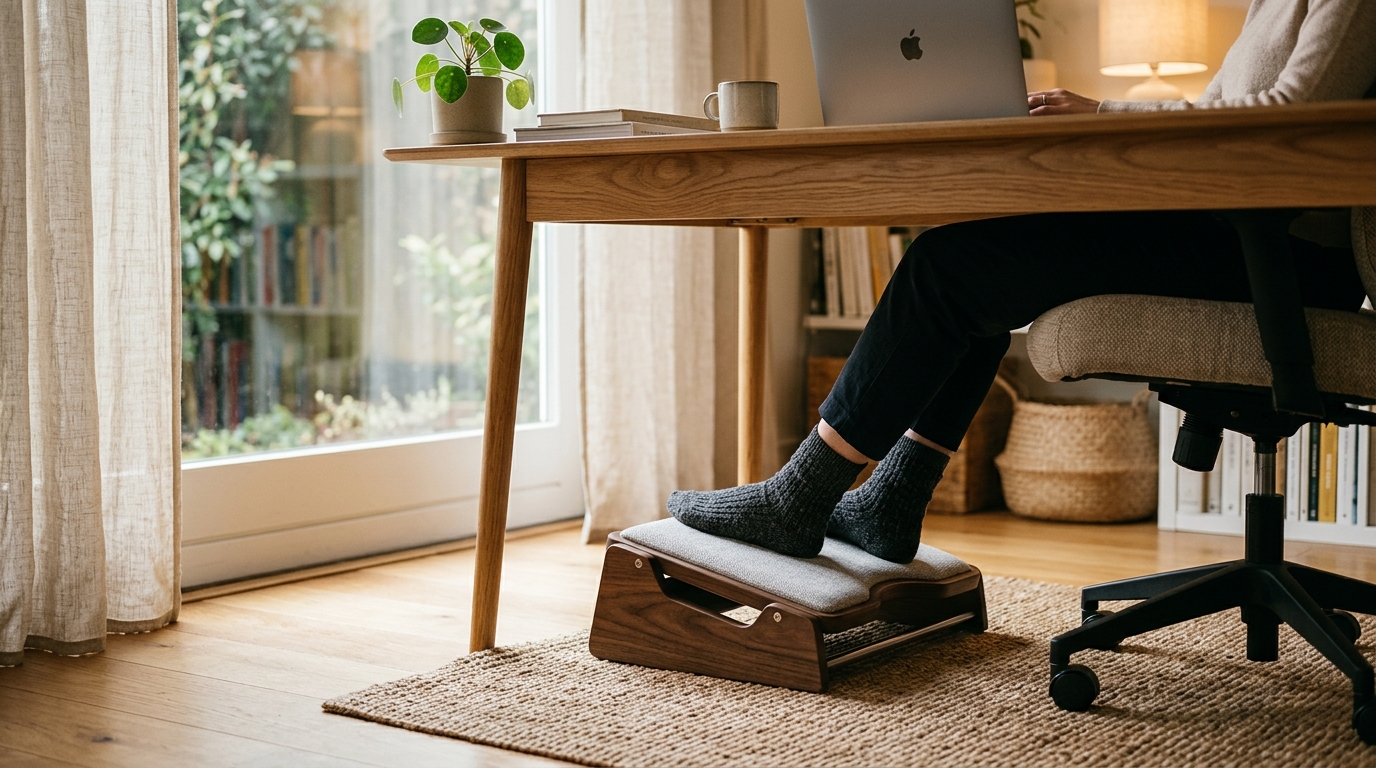
The Humanscale FR500 is the best under-desk footrest for most people — it delivers firm, adjustable-angle support built to last a decade, and the foot motion mechanism keeps circulation moving during long sits. Budget pick: VIVO Ergonomic Adjustable Foot Rest at roughly half the price. A footrest matters most when your chair must sit high enough for the desk surface, leaving your feet dangling — a situation that quietly causes lower-back strain, hip tightness, and leg fatigue all day long.
Why an under-desk footrest changes how you sit
Proper seated ergonomics require your hips to be at or slightly above knee height, thighs roughly parallel to the floor, and feet flat on a surface. In the real world, most desk-and-chair combinations don’t land there: a fixed-height desk at standard 29–30 inches means a shorter person must raise their chair to reach a comfortable typing height — and their feet never touch the floor.
A footrest fills that gap. It becomes the floor for your feet, allowing you to set chair height correctly without legs dangling. The result: thighs stop compressing against the seat pan, lumbar support starts working as intended, and the chronic low-grade hip and back fatigue most office workers attribute to “just sitting all day” largely disappears.
There are two functional categories:
- Stationary/platform footrests: a firm angled surface, usually with a textured top. No movement — just a stable elevated floor replacement. Best for users who want a reliable, fuss-free solution.
- Motion/rocking footrests: a platform that tilts or rocks under foot pressure, promoting micro-movement in the feet and lower legs. This stimulates circulation and reduces the stiffness associated with long stationary sits. Best for users who sit 6+ hours per day.
The honest verdict: if you sit 4+ hours daily, a rocking-style footrest adds real value. If you primarily want to fix the “feet dangling” problem, a quality stationary platform is sufficient.
Quick comparison
| Product | Best for | Rating | Notes | |
|---|---|---|---|---|
| Humanscale FR500 | best overall — motion footrest with firm support | ★★★★★ | $90-130. Adjustable angle. Foot-motion mechanism. | Check price |
| Kensington SoleMate Plus | best mid-range adjustable height footrest | ★★★★★ | $50-70. 4-inch height adjustment. Massage surface. | Check price |
| VIVO Ergonomic Adjustable Foot Rest | best budget platform footrest | ★★★★☆ | $30-45. Adjustable angle. Non-slip mesh surface. | Check price |
| Fellowes Professional Foot Rocker | affordable rocking style | ★★★★☆ | $30-40. Gentle rocking motion. Textured surface. | Check price |
| Mind Reader Lap Dog Footrest | ultra-budget stationary option | ★★★★☆ | $20-30. Fixed angle. Basic platform. | Check price |
The picks
Best overall: Humanscale FR500
Best for anyone who sits 4+ hours daily and wants the definitive under-desk footrest
Humanscale FR500 Ergonomic Footrest
The Humanscale FR500 is what occupational therapists and ergonomic consultants actually recommend — and it earns that reputation. The platform adjusts in angle from flat to roughly 20 degrees and features a built-in motion mechanism: as you use the footrest naturally, the platform rocks and pivots slightly in response to foot pressure, promoting subtle leg-muscle engagement and preventing the static-hold fatigue that stationary footrests accumulate over a long workday. The textured surface prevents slip without requiring active foot gripping. Construction is solid enough that Humanscale backs it with a lifetime warranty on the mechanism. At $90-130, it is the most expensive option in this guide — and the one most likely to still be under your desk in ten years.
★★★★★ 4.7 · 3,800 reviews
Check current price on Amazon→Pros
- Motion mechanism actively promotes foot and lower-leg circulation during long sits
- Firm platform holds its angle without flex under foot weight
- Textured surface grips socks and shoes equally well
- Lifetime warranty from Humanscale (a company that actually honors warranties)
- Low-profile design fits under most desks without clearance issues
Cons
- $90-130 is the highest price in the category — roughly 3x the budget alternatives
- Motion mechanism has a learning curve; some users initially find the movement distracting
- Single height (angle-adjustable only); not ideal for users who need significant height lift
- Minimal color options — typically charcoal or black only
Best mid-range: Kensington SoleMate Plus
Best for users who need both height and angle adjustment — especially shorter users
Kensington SoleMate Plus Height-Adjustable Footrest
The Kensington SoleMate Plus is the right choice when you need genuine height adjustment, not just angle adjustment. The platform raises up to 4 inches above desk floor level in discrete steps, which accommodates users in a range of heights and desk situations that a flat-angle-only footrest cannot. It also includes a textured massage-surface top that many users prefer for longer sessions. At $50-70 it is priced between budget options and the Humanscale FR500 — a reasonable middle ground for users with significant height-gap needs.
★★★★★ 4.5 · 5,200 reviews
Check current price on Amazon→Pros
- Up to 4 inches of height adjustment — best range in this category
- Angle also adjustable independently of height (rare combination)
- Massage-texture surface is comfortable for sock or barefoot use
- Kensington brand reliability; widely available for returns/replacement
- Works with most desk depths; compact footprint
Cons
- Height adjustment uses discrete steps (not infinite) — may not land exactly where you want
- Platform surface is smaller than the Humanscale FR500
- No motion mechanism; purely stationary platform
- Plastic construction feels less premium than Humanscale at a lower price difference than you'd expect
Best budget: VIVO Ergonomic Adjustable Foot Rest
Best for users who want a reliable adjustable footrest without spending over $40
VIVO Ergonomic Adjustable Under Desk Foot Rest
VIVO makes well-regarded ergonomic accessories at honest prices, and their adjustable footrest is the value benchmark for this category. The platform adjusts through several angle positions, the mesh-top surface breathes well and grips both shoes and socks, and the overall construction holds up to daily use without wobble or flex. It won't match the Humanscale FR500's motion mechanism or build quality, but it solves the fundamental problem — feet off the floor, supported at the right height and angle — for around $30-45. This is the right call if you're new to footrests and want to confirm the ergonomic benefit before spending more.
★★★★☆ 4.4 · 9,100 reviews
Check current price on Amazon→Pros
- Adjustable angle covers the range most users need
- Mesh top surface breathes and grips well
- Wide enough platform to accommodate both feet comfortably side by side
- Under $45 makes this an easy first footrest purchase
- Stable base — doesn't slide on hard floors or carpet
Cons
- No motion mechanism; static platform only
- Height is fixed (angle only) — won't help users who need significant elevation
- Plastic construction shows wear faster than Humanscale or Kensington
- VIVO branding is minimal (a positive for some, neutral for others)
Best rocking motion: Fellowes Professional Series Foot Rocker
Best for users who want active foot motion on a budget — under \$40
Fellowes Professional Series Foot Rocker
The Fellowes Foot Rocker is the affordable entry to motion-style footrests. It rocks front-to-back in response to foot pressure, promoting the ankle flexion and lower-leg engagement that static footrests eliminate. The rocking is gentle — not like a balance board — and most users adapt within a day or two. At $30-40, it brings a meaningful functional upgrade over flat stationary platforms at not much more money. It's not as refined as the Humanscale FR500's pivot mechanism, but for users who sit all day and want to avoid the circulation stiffness of a fully static foot position, it's the right price-to-benefit choice.
★★★★☆ 4.3 · 4,700 reviews
Check current price on Amazon→Pros
- Rocking motion promotes ankle flexion and lower-leg circulation
- Under $40 makes it the lowest-cost motion footrest option
- Textured surface prevents slip during forward/back rocking
- Compact size stores easily under almost any desk
Cons
- Rocking only (no angle or height adjustment)
- Motion mechanism is less refined than Humanscale — slight plastic-on-plastic noise on some units
- Not for users who prefer a stable, stationary footrest
- Small platform — best for smaller foot sizes; may feel cramped for larger feet
What to skip
-
Smooth plastic platform footrests under $20. Without a textured surface, your feet actively grip the platform to stay in place — fatiguing the very muscles a footrest is supposed to rest. Any footrest without a non-slip surface is a functional downgrade.
-
Footrests marketed as “memory foam pillow” style. Soft foam compresses immediately under foot weight and offers no real platform support. These are neck/lumbar pillows being sold in the wrong product category.
-
Overly thick footrests (5+ inches). A footrest that raises your feet too high tips your pelvis forward, worsening lower-back posture rather than improving it. Most users need 2-4 inches of elevation at most; measure your actual gap before buying.
-
Balance boards as footrests. Balance boards belong in the standing-desk context. Under a seated desk, they create hip instability that fatigues your stabilizing muscles without ergonomic benefit. Use an actual footrest when seated.
How to know if you need a footrest
Sit in your normal working position with your chair adjusted so your forearms rest comfortably on the desk. Now check your feet: are they flat on the floor, or are they dangling or pressing on tiptoe? If dangling or tiptoeing, you need a footrest. If flat and comfortable, your setup is already optimized and a footrest won’t help.
The gap between your feet and the floor is the number to measure. Typical under-desk footrests raise the foot surface 2-4 inches. Users needing more than 4 inches of elevation should also look at whether a height-adjustable standing desk is a better long-term solution.
FAQ
Frequently asked questions
Do under-desk footrests actually help with back pain?
What height footrest do I need?
Stationary vs rocking footrest — which is better?
Can I use a footrest while using a standing desk?
Are footrests good for short people specifically?
Can I use a footrest with any chair?
Bottom line
Best overall: Humanscale FR500 — the motion mechanism and lifetime build quality justify the $90-130 price for daily users. Best mid-range: Kensington SoleMate Plus if you need genuine height adjustment. Best budget: VIVO Ergonomic Adjustable Foot Rest for under $45. Skip smooth-platform bargain-bin options entirely.
Pair your footrest with the right ergonomic chair, a correct desk height, and lumbar support for the complete seated ergonomics stack. If lower-back pain persists despite a footrest, see the how to reduce lower-back pain from sitting guide for additional interventions.