roundups
Best Ergonomic Foot Rests for Office Use (2026 Picks)
Independent foot rest picks across rocking, fixed, height-adjustable, and active-movement categories. Built from ergonomics data and long-term comfort reports.
 Daniel Osei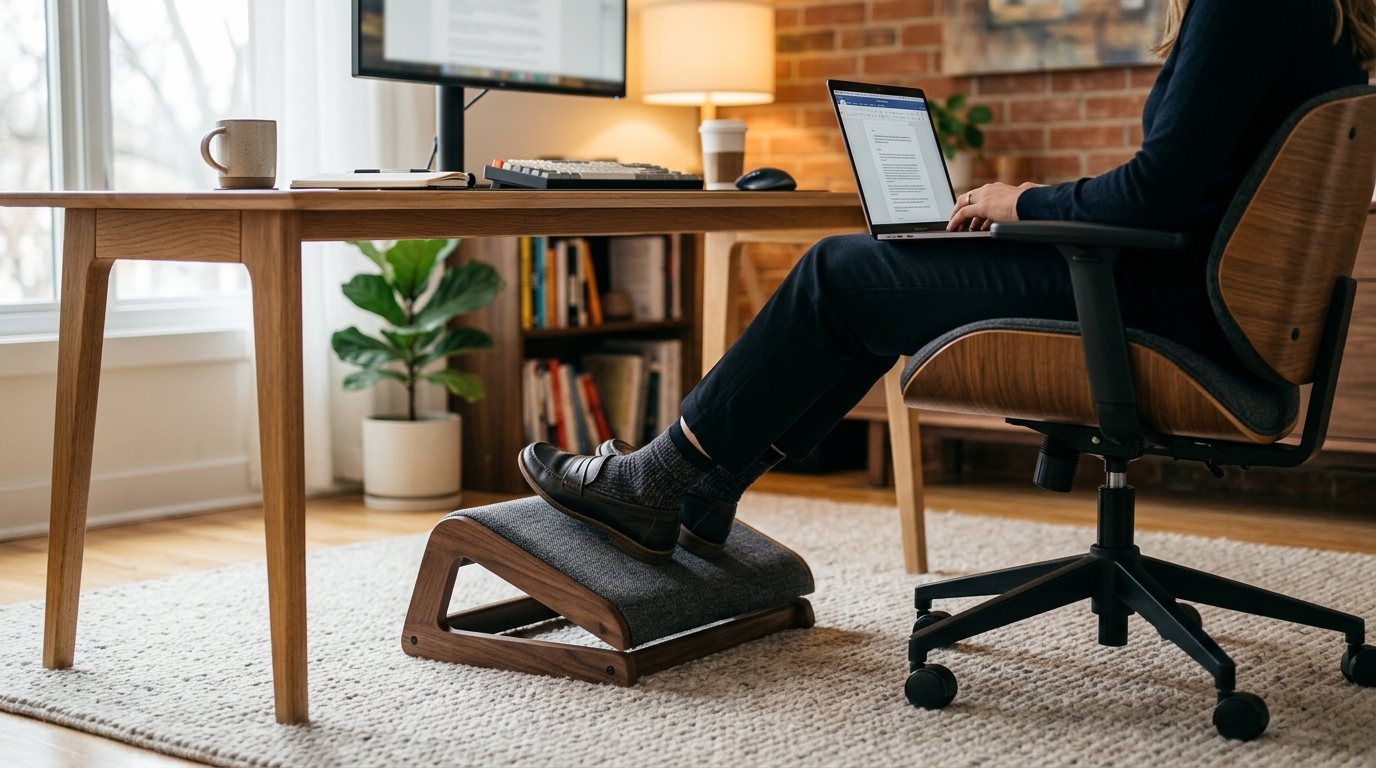
A foot rest is the cheapest ergonomic fix for a problem most home offices don’t realize they have. If your chair is correctly adjusted (thighs parallel to the floor, knees slightly below hip level) but your feet don’t comfortably reach the ground, you’re going to round your lower back or extend your toes for hours at a time. Both lead to the same lower-back stiffness — and a $30 piece of angled foam under your desk fixes it.
The category is small but genuinely useful when you need it. This guide covers the four sub-categories — fixed-angle, height-adjustable, rocking, and active-movement — and the cases where each is the right answer.
Do you actually need a foot rest? The quick test
Sit at your desk, in your chair, with the chair adjusted so:
- Your thighs are parallel to the floor (the back of your knees just clears the seat edge)
- Your forearms rest level with your desk surface when typing
Now look at your feet. Three possible outcomes:
- Feet land flat on the floor, comfortably weight-bearing. You don’t need a foot rest.
- Toes barely touch, or your feet float off the ground entirely. You need a foot rest.
- Feet land flat but knees are below hip level (thighs angled downward). Your chair is too low, not your foot situation. Raise the chair and re-evaluate.
The honest target audience for a foot rest: users under 5’5” using a desk and chair sized for a 5’10” reference, or users at any standing desk who sit at the elevated desk position with the chair raised to compensate.
Quick comparison
| Product | Best for | Rating | Notes | |
|---|---|---|---|---|
| Height-adjustable angled platform foot rest | best overall for most home offices | ★★★★★ | ~$40-80. Tilt + height adjustable. Non-slip surface. | Check price |
| Fixed-angle wedge foot rest (foam or wood) | single user; simplest setup | ★★★★★ | ~$25-60. One fixed angle (~15-20°). | Check price |
| Rocking foot rest (curved bottom) | circulation-focused; movement during work | ★★★★★ | ~$40-80. Rocks 15-25° front-to-back. | Check price |
| Active-movement foot rest (rollers / texture) | active foot movement and ankle ROM during work | ★★★★☆ | ~$60-130. Rollers, balance disc, or massage textures. | Check price |
| Memory foam foot cushion (no tilt) | budget; floor-level foot support without angle change | ★★★★☆ | ~$25-45. Soft, no tilt, washable cover. | Check price |
The picks
Best overall — height-adjustable angled platform
Best for most home offices; the safe default that fits 5'2″ to 6'0″ users
Adjustable Tilt and Height Foot Rest (Office)
The adjustable platform is the right answer for most buyers. Height steps from roughly 3 to 6 inches, tilt angles from 0 to 30 degrees, non-slip top surface. You set it once for your seated posture and forget it. The mechanism is usually a simple lever or knob — nothing complex to fail. If you ever change chairs (or a partner uses the same desk), you can re-adjust in 10 seconds rather than buying a different stand.
★★★★★ 4.6 · 3,100 reviews
Check current price on Amazon→Pros
- Fits the height-and-tilt math for most users 5'2"-6'0"
- Non-slip top surface — your feet don't slide off during the day
- Adjustment mechanism rarely fails — simple lever or knob
- Footprint stays under your desk; you can roll your chair over it
Cons
- Top surface is often hard plastic — fine over socks, scratchy on bare feet
- Adjustment levers loosen over time on cheaper models
- Static — no movement engagement (if you want that, see rocking or active-movement)
Best simple — fixed-angle wedge foot rest
Best for single user, one desk, no need for adjustment
Fixed-Angle Foam or Wood Wedge Foot Rest
A fixed-angle wedge is the simplest possible answer. One tuned ergonomic angle, no moving parts, no adjustment. Foam wedges are softer and lighter; wooden wedges are firmer and last longer. Both work. Pick the firmer option if you'll be using shoes; pick the softer option if you sit in socks or barefoot.
★★★★★ 4.5 · 1,700 reviews
Check current price on Amazon→Best for circulation — rocking foot rest
Best for long sitting bouts where ankle and calf engagement helps circulation
Rocking Foot Rest (Curved Bottom)
A rocking foot rest has a curved bottom that lets you tilt your feet forward and backward through 15-25 degrees of motion. Engages the calf, ankle, and tibialis anterior — the muscles whose contraction helps return blood from your feet back up your legs (the calf pump). For 6+ hour seated days, this is the most-studied form of movement-based ergonomic add-on after the standing desk itself.
★★★★★ 4.5 · 1,200 reviews
Check current price on Amazon→Best for active movement — roller / textured foot rest
Best for users who want active foot movement and plantar fascia mobilization during work
Active Foot Rest with Rollers or Massage Surface
Active foot rests put rollers, balance discs, or textured massage surfaces under your feet. The movement is voluntary — you actively roll your feet during work — which keeps your ankle and arch engaged. Particular value for users with plantar fasciitis or chronic foot tension; the rolling acts like a low-grade massage during the workday. Not a static replacement for a normal foot rest; pair with one if you also need height/angle adjustment.
★★★★☆ 4.4 · 680 reviews
Check current price on Amazon→Best budget — memory foam foot cushion
Best for users whose feet reach the floor but want padding for prolonged barefoot/sock-foot use
Memory Foam Foot Cushion (No Tilt)
A memory foam foot cushion is the right pick when you don't need height adjustment — your chair is fine, your feet reach the floor, you just want padding for your soles. Sat-on-floor effect with no angle change. The category is dominated by car-cushion-style products marketed for office use; the same foam is fine. Cleanable washable cover is the spec to check.
★★★★☆ 4.3 · 2,400 reviews
Check current price on Amazon→The math — how to set foot-rest height correctly
The right foot-rest height depends on:
- Your chair seat height (from floor to where your sit-bones land)
- Your lower-leg length (from floor to back of the knee, when seated naturally)
The simple version: adjust the foot rest until your thighs are parallel to the floor with your feet flat on it. That’s the geometry. If the angle is also adjustable, set it so your toes are slightly elevated (5-15 degrees) — this keeps your calf engaged and helps blood return.
A common mistake on adjustable foot rests: setting them too high so your knees rise above hip level. That compresses the back of your thighs and reduces circulation; you want the same parallel-thigh posture you’d have if your feet were on the floor naturally.
When a foot rest is the wrong fix
A foot rest is the right fix for one specific problem: your feet aren’t reaching the floor at your correct chair height. Two adjacent situations need different fixes:
- Feet reach the floor but your lower back still aches. This is a chair lumbar support problem, not a foot problem. See our ergonomic chairs roundup.
- You sit at a standing desk that’s too tall and adjust your chair higher to compensate. Lower the desk to fit the chair-floor geometry. Standing desks are sit-stand desks for a reason; the sit position should still be at standard desk height.
If you have either of these patterns and add a foot rest anyway, you may feel better temporarily but you haven’t addressed the actual cause.
Year-3 failure patterns
The reports that inform a real buying decision:
- Adjustment-knob stripping on plastic-only mechanisms at year 1-2. Metal-insert knobs hold up dramatically longer.
- Non-slip top-surface wear at year 1.5-3. The textured silicone or rubber polishes smooth and your feet start sliding. Replaceable on some models, not on others — verify before buying.
- Foam compression on memory-foam cushions at year 1-2. The cushion goes flat at the heel impression and never recovers. Washing the cover periodically helps maintain visual quality but doesn’t bring back the foam.
- Rocking foot rest squeak at year 1-2 if the rocker has any metal-on-plastic contact points. Silicone spray ($5) usually fixes it.
- Carpet vs hardwood durability difference — foot rests sized to slide between rolling-chair casters get scuffed on hardwood; on carpet, the same rests barely show wear.
FAQ
Frequently asked questions
Will a foot rest help my lower back pain?
Should I use a foot rest at a standing desk?
Rocking foot rest or static — which is better?
How tall should a foot rest actually be?
Can I just use a stack of books?
How to pick yours
- Confirm you actually need one with the quick test above. If your feet reach the floor at correct chair height, you don’t need a foot rest.
- Default to a height-adjustable angled platform for most users. It fits the math for everyone in the household.
- Pick fixed-angle if simplicity matters and the desk has one user. No moving parts to fail.
- Add active-movement (rockers or rollers) if you sit deeply for 4+ hour stretches. The circulation benefit is meaningful.
- Verify the non-slip surface and adjustment mechanism quality. These are the parts that fail first.
For full home-office context, see our setup guide. Pair a foot rest with a properly adjusted ergonomic chair and a standing desk that sits-and-stands rather than just standing, and an anti-fatigue mat for the standing position.