roundups
Best Under-Desk Bike Pedals 2026
The best under-desk bike pedals for staying active at work. Quiet pedal exercisers and desk bikes ranked by noise, resistance, and footprint.
 Daniel Osei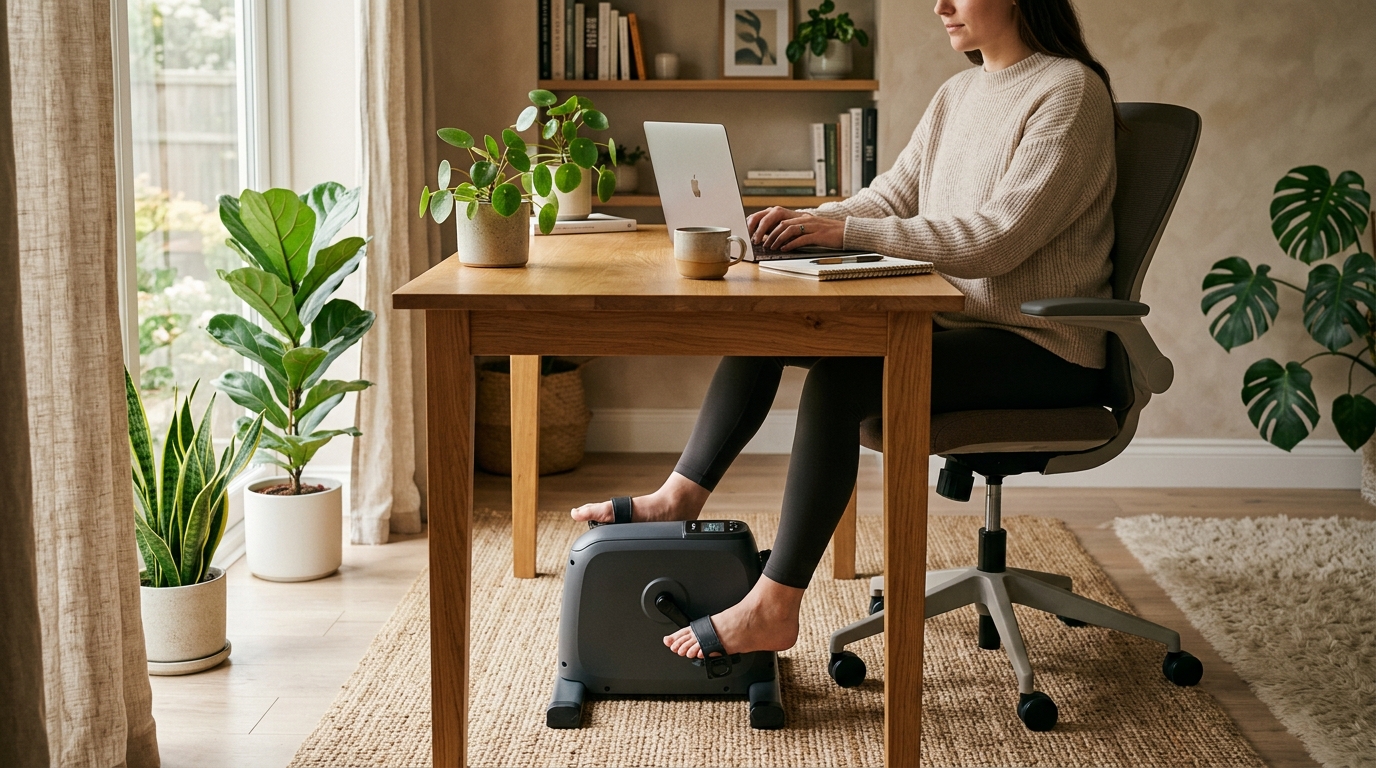
The DeskCycle 2 is the best under-desk bike pedal for most office workers — magnetic resistance keeps it under 45 decibels at any resistance level, and a 10-inch clearance height fits beneath virtually every standard desk. For users with knee sensitivity, the Cubii Pro delivers a smoother elliptical foot path at the same compact footprint.
Sedentary desk work is the default for most office jobs, and the research on prolonged sitting is clear: metabolic rate drops, circulation slows, and lower-back tension accumulates across a standard eight-hour workday. Under-desk bike pedals address this without requiring a schedule change, a gym bag, or a separate workout block. A pedal exerciser slides under the desk, stays there, and lets you add low-intensity leg movement during calls, reading, and deep-focus work. The five picks below cover the full range of needs — from a $45 budget entry point to a full desk-and-bike combination that replaces the chair entirely.
What separates a good desk bike pedal from a cheap one?
Under-desk pedal exercisers range from $40 to $600, and the difference in day-to-day usability between a $40 option and a $160 option is significant. Four variables determine whether a unit will actually get used:
Noise level: Cheap pedal exercisers use friction-based resistance that produces an audible mechanical whir at moderate to high settings. Magnetic resistance units like the DeskCycle 2 run near-silently by comparison. On a video call, a friction pedaler is noticeable to other participants; a magnetic one is not.
Stability on the floor: Lightweight pedal exercisers slide across hard floors during sustained pedaling, requiring constant repositioning. Units with textured rubber feet and a heavier base — typically above 12 pounds — stay anchored without a mat underneath.
Pedal height clearance: The clearance requirement is measured at the top of the pedal stroke, not the center of the unit. The DeskCycle 2 requires only 10 inches — most other under-desk units need 12 to 14 inches. Measure the vertical space from the floor to the underside of the desk apron before ordering.
Resistance range: Single-tension units are adequate for casual light movement but cannot provide a meaningful workout outside office hours. An 8-level magnetic resistance range lets you use the same unit for active recovery sessions during calls and higher-intensity intervals in the evening.
Quick comparison
| Product | Best for | Rating | Notes | |
|---|---|---|---|---|
| DeskCycle 2 | best overall under-desk pedal exerciser | ★★★★★ | $170-200. Magnetic resistance, 8 levels, sub-45dB, 10-inch clearance, LCD display. | Check price |
| Cubii Pro Under-Desk Elliptical | best for knee comfort and app tracking | ★★★★★ | $250-350. Elliptical motion, Bluetooth, 8 resistance levels, syncs with fitness apps. | Check price |
| Sunny Health and Fitness Mini Cycle | best budget pedal exerciser | ★★★★☆ | $40-65. Friction resistance, tension dial, basic LCD, lightweight at 8 pounds. | Check price |
| LifePro FlexCycle Under-Desk Bike | best Bluetooth bike at mid-range price | ★★★★☆ | $130-160. Magnetic resistance, Bluetooth, 8 levels, app-connected, quiet operation. | Check price |
| FlexiSpot Desk Bike V9U | best full desk-and-bike combo chair | ★★★★★ | $400-550. Integrated seat and work surface, height adjustable, replaces standing desk chair. | Check price |
The picks
Best overall under-desk pedal exerciser: DeskCycle 2
Best for office workers who want a quiet, stable pedal exerciser that fits under a standard desk without interrupting meetings or coworkers
DeskCycle 2 Under-Desk Bike Pedal Exerciser
The DeskCycle 2 is the benchmark by which all other under-desk pedal exercisers are measured. Magnetic resistance instead of friction resistance keeps operational noise at or below 40 decibels — below the ambient noise floor in most open offices and inaudible on video calls at any resistance setting. Eight resistance levels cover the range from light leg circulation during focused work to a genuine low-intensity cardio session during off-hours. The clearance requirement is 10 inches at the top of the pedal stroke, which fits under virtually all standard desk heights without requiring raised desk legs or special mounting. The LCD panel tracks RPM, calories, distance, and time without requiring a smartphone or app — a feature that matters on a desk already managing several cables and devices. At 14 pounds with rubber feet on all corners, the unit stays anchored on both hard floors and carpet. The DeskCycle 2 is not cheap at $170-200, but the absence of pedal noise in a shared office environment justifies that delta over budget alternatives within a week of daily use.
★★★★★ 4.7 · 4,800 reviews
Check current price on Amazon→Pros
- Sub-40-decibel operation — quieter than most office ambient noise and inaudible to video call participants
- Only 10 inches of desk clearance required — fits under standard 30-inch desk heights without modification
- 8 magnetic resistance levels cover light movement through low-intensity cardio in the same unit
- LCD display shows RPM, calories, distance, and time without requiring an app or Bluetooth pairing
- Weighted base with rubber feet on all corners keeps the unit anchored on hardwood, tile, and carpet
Cons
- $170-200 is among the higher price points in the pure under-desk pedal exerciser category
- No Bluetooth connectivity — workout data stays on the LCD and cannot sync to a fitness tracking app
- Circular pedal motion may aggravate existing knee conditions; consider the Cubii Pro for elliptical motion instead
- At 14 pounds, it is not a unit you move between rooms frequently — works best in a fixed desk position
Best for knee comfort and app tracking: Cubii Pro Under-Desk Elliptical
Best for users with prior knee sensitivity or anyone who wants workout data synced automatically to Apple Health, Fitbit, or MyFitnessPal
Cubii Pro Under-Desk Elliptical
The Cubii Pro uses an elliptical foot path rather than a circular pedaling motion. That distinction matters for users with any existing knee sensitivity because the elliptical motion eliminates the dead spot at the top of a circular pedal stroke — the moment where the knee tracks forward past neutral alignment and stress on the patellar tendon peaks. The result is a noticeably smoother sensation during long desk sessions at low resistance. Bluetooth connectivity syncs to the Cubii app as well as Apple Health, Fitbit, and MyFitnessPal, giving workers who track activity data a real record of desk movement integrated with the rest of their health stack. Eight resistance levels, a low profile that fits under standard desks, and a compact footprint make the Cubii Pro a complete solution for the active office worker. The price premium over the DeskCycle 2 is roughly $50 to $150 depending on current pricing — that gap is justified if knee comfort or app integration are priorities, but unnecessary for users without either of those needs.
★★★★★ 4.5 · 3,200 reviews
Check current price on Amazon→Pros
- Elliptical foot path reduces knee stress at the top of the pedal stroke compared to a circular motion
- Bluetooth syncs to the Cubii app, Apple Health, Fitbit, and MyFitnessPal for integrated activity tracking
- Smooth, quiet operation at all resistance levels — comparable to DeskCycle 2 in open-office noise profile
- Compact footprint slides fully under most desks without protruding past the chair base
- 8 resistance levels provide adequate range for both light circulation and moderate low-impact movement
Cons
- $250-350 is a significant premium over circular-pedal alternatives with comparable noise levels
- Elliptical motion requires slightly more floor space front-to-back than a circular pedal unit of the same width
- App and subscription features have changed across product generations — verify current app status before purchasing
- Maximum resistance is modest — not suitable for users who want a genuinely challenging workout from a desk pedaler
Best budget option: Sunny Health and Fitness Mini Cycle Pedal Exerciser
Best for anyone who wants basic leg movement during desk work at minimum cost and does not require silent operation
Sunny Health and Fitness Mini Cycle Pedal Exerciser
The Sunny Health and Fitness Mini Cycle is the right answer when the budget is under $65 and the goal is straightforward: some leg movement during desk hours rather than none. Friction resistance adjusted by a center tension knob delivers functional resistance across multiple levels without magnetic components, keeping the price accessible and the mechanism simple. The trade-off is noise — at moderate resistance levels, friction pedal exercisers produce an audible mechanical whir that is noticeable in quiet offices and perceptible on video calls. For home offices, private offices, or hybrid workers who pedal only during solo focused work, that limitation is irrelevant. The LCD panel tracks the same core metrics as premium units: RPM, time, distance, and approximate calorie burn. At 8 pounds without rubberized feet, it does slide on hard floors under sustained pedaling — a non-slip mat underneath solves that problem completely. For anyone not yet certain whether a desk pedal exerciser is something they will actually use daily, the Sunny Health mini cycle is the lowest-risk way to find out before committing to a $170-plus magnetic unit.
★★★★☆ 4.3 · 9,600 reviews
Check current price on Amazon→Pros
- Under $65 makes it the lowest-risk entry point for testing whether you will actually use a desk pedal exerciser
- Friction resistance with multiple adjustment levels covers the range needed for light to moderate movement
- LCD display tracks RPM, time, distance, and calorie burn without requiring a phone, app, or Bluetooth
- Small footprint and 8-pound weight make it easy to reposition or move to storage when not in use
- No subscription service or app dependency required to access any functionality on the unit
Cons
- Friction resistance is audible at moderate and high settings — not suitable for open offices or video calls
- Lightweight construction causes sliding on hard floors during sustained pedaling; pair with a non-slip mat
- Build quality shows visible wear over 12 to 18 months of daily use compared to magnetic resistance alternatives
- No carry handle — moving it between rooms requires picking up the unit by the pedal arms
Best Bluetooth connected at mid-range price: LifePro FlexCycle
Best for active data trackers who want magnetic resistance and app connectivity without paying the Cubii Pro premium price
LifePro FlexCycle Under-Desk Bike
The LifePro FlexCycle sits between the DeskCycle 2 and the Cubii Pro on the price-to-feature curve. Magnetic resistance keeps operation quiet enough for open offices and video calls across all resistance settings. Bluetooth connectivity pushes workout data to the LifePro app, which tracks sessions over time and allows daily movement goal setting. Eight resistance levels span a useful range from light recovery movement to a moderate cardio effort. The pedaling motion is circular rather than elliptical, making it more comparable to the DeskCycle 2 in knee-stress profile. At $130-160, the FlexCycle delivers the two main advantages of the DeskCycle 2 — magnetic resistance and quiet operation — plus app connectivity, at a price point roughly $40 to $90 below the Cubii Pro. The LifePro unit is slightly larger and heavier than the DeskCycle 2, which helps stability on the floor but limits clearance on lower desk aprons. If app data tracking matters and a circular pedal motion is acceptable, the FlexCycle is the most economical path to both features simultaneously.
★★★★☆ 4.4 · 2,100 reviews
Check current price on Amazon→Pros
- Magnetic resistance delivers quiet operation suitable for open offices and video calls at all resistance settings
- Bluetooth app connectivity tracks sessions over time, sets daily movement goals, and shows progress trends
- $130-160 pricing undercuts the Cubii Pro by $40 to $190 while offering comparable core functionality
- Weighted base and rubberized feet provide stable pedaling on both hardwood floors and carpet surfaces
- 8 resistance levels accommodate both light desk movement and higher-intensity off-desk use
Cons
- Circular pedal motion rather than elliptical — not the right choice for users with existing knee sensitivity
- Slightly larger footprint than the DeskCycle 2 — verify clearance under lower desks before purchasing
- LifePro app has fewer third-party integrations than the Cubii app — no direct Apple Health or Fitbit sync
- Brand reliability track record is shorter than DeskCycle or Cubii for long-term daily-use confidence
Best full desk-and-bike combination: FlexiSpot Desk Bike V9U
Best for remote workers and home-office users who want to pedal at moderate intensity for two or more hours per day without switching between a chair and a pedal unit
FlexiSpot Desk Bike All-In-One V9U
The FlexiSpot Desk Bike is a fundamentally different category from under-desk pedal exercisers. It replaces the chair and the pedal unit with a single object: an adjustable-height bike seat integrated with an attached work surface at laptop or notebook height. This design solves the positioning problem that all under-desk pedal exercisers share — the need to find a chair height that accommodates both comfortable seated work and a comfortable pedal stroke simultaneously. On a dedicated desk bike, the seat height, crank position, and work surface height are all calibrated together. The result is a more ergonomically coherent cycling position for extended sessions without the postural compromise of pedaling from a conventional desk chair. The FlexiSpot V9U height range of 33 to 49 inches covers most users from five feet to six feet two inches, and three resistance levels are appropriate for sustained moderate-pace desk movement. At $400-550, the V9U represents a significant purchase — the right call for home-office users committed to active working for several hours daily, not for anyone still testing whether desk movement is a habit worth building.
★★★★★ 4.5 · 1,300 reviews
Check current price on Amazon→Pros
- Integrated seat and work surface eliminates the ergonomic mismatch between chair height and pedal position
- Height range of 33 to 49 inches fits most users between 5 feet and 6 feet 2 inches at the desk
- No separate chair needed — reduces total desk furniture footprint while adding active movement throughout the day
- Work surface is large enough for a laptop, notebook, and drink simultaneously
- Genuine moderate-intensity cardio output is achievable at higher resistance — meaningful exercise, not just fidgeting
Cons
- $400-550 is a major investment — only justified for home-office users committed to sustained daily pedaling
- Work surface height is lower than a standard desk — requires a separate monitor arm or external display for ergonomic screen viewing
- Not a substitute for an ergonomic chair during non-pedaling work blocks — two-furniture setups are common for hybrid users
- Delivery and assembly require more logistics than a compact pedal exerciser that ships in a small box
What to skip
Resistance band desk attachments: Products marketed as under-desk resistance bands for arms and legs rarely deliver consistent resistance during cognitive work and require active attention to use, producing no passive movement benefit during calls or focus sessions. They address an entirely different use case from pedal exercisers.
Mini bikes with combination arm cranks: Dual arm-and-leg pedal units designed for seated exercise create an awkward ergonomic posture at a desk — the arm cranks demand active engagement that pulls attention away from the screen and keyboard and disrupts cognitive work. A dedicated under-desk pedal unit keeps leg movement passive while leaving arms and hands completely free.
Smart pedal exercisers requiring monthly subscriptions: Several newer entrants lock resistance controls behind a paid subscription that must be accessed through the companion app. Verify the subscription model before purchasing. A pedal exerciser that cannot adjust resistance without a live app subscription becomes unusable if the service changes pricing or is discontinued.
How to choose the right under-desk bike pedal for your setup
Work through three questions before buying:
-
What is your desk clearance? Measure the vertical space from the floor to the underside of the desk apron or drawer rail. Under 11 inches: only the DeskCycle 2 fits comfortably. 11 to 14 inches: all standard under-desk pedal units work. Over 14 inches: full desk bike combinations become viable.
-
Do you have knee sensitivity? If yes, start with the Cubii Pro or another elliptical-motion unit. The circular pedal stroke in most under-desk bikes creates stress at the top of the pedal arc that can aggravate patellar tendinopathy and IT band issues over sustained desk sessions.
-
Is your work environment shared or open? In an open office or on frequent video calls, magnetic resistance is not optional — it is a baseline requirement. Budget friction-resistance units are workable only in private home offices where noise affects no one else.
If the goal is casual movement during calls and reading blocks, any magnetic-resistance unit works. If the goal is measurable daily activity tracked toward a calorie or step target, add Bluetooth connectivity. If the goal is full moderate-intensity exercise sustained across a workday, a dedicated desk bike combination is the correct category to consider.
FAQ
Frequently asked questions
Do under-desk bike pedals actually burn calories?
Will a desk pedal exerciser slide around on a hard floor?
Can other people hear under-desk bikes during video calls?
What desk clearance do I need for an under-desk pedal exerciser?
Is a desk bike better for you than a standing desk?
How long before you notice benefits from daily desk pedaling?
Bottom line
The DeskCycle 2 is the correct starting point for most office workers: magnetic resistance stays silent during calls, the 10-inch clearance fits under standard desks, and the no-app-required LCD panel tracks the basics. For knee-sensitive users or app-connected tracking, spend the premium on the Cubii Pro. Budget-constrained workers testing whether desk pedaling is a habit worth building should start with the Sunny Health mini bike at $40-65 before committing to a $170-plus magnetic unit. The FlexiSpot desk bike is a separate category and makes sense only for home-office users committed to daily extended active sessions.
For the complete active-office setup: best under-desk treadmills, best standing desks, how to set up an ergonomic workstation, best ergonomic desk setup guide.