roundups
Best Under-Desk Treadmills of 2026
Best under-desk treadmills of 2026: walking pads that fit beneath standing desks, cut sedentary time, and let you type at a gentle walking pace.
 Daniel Osei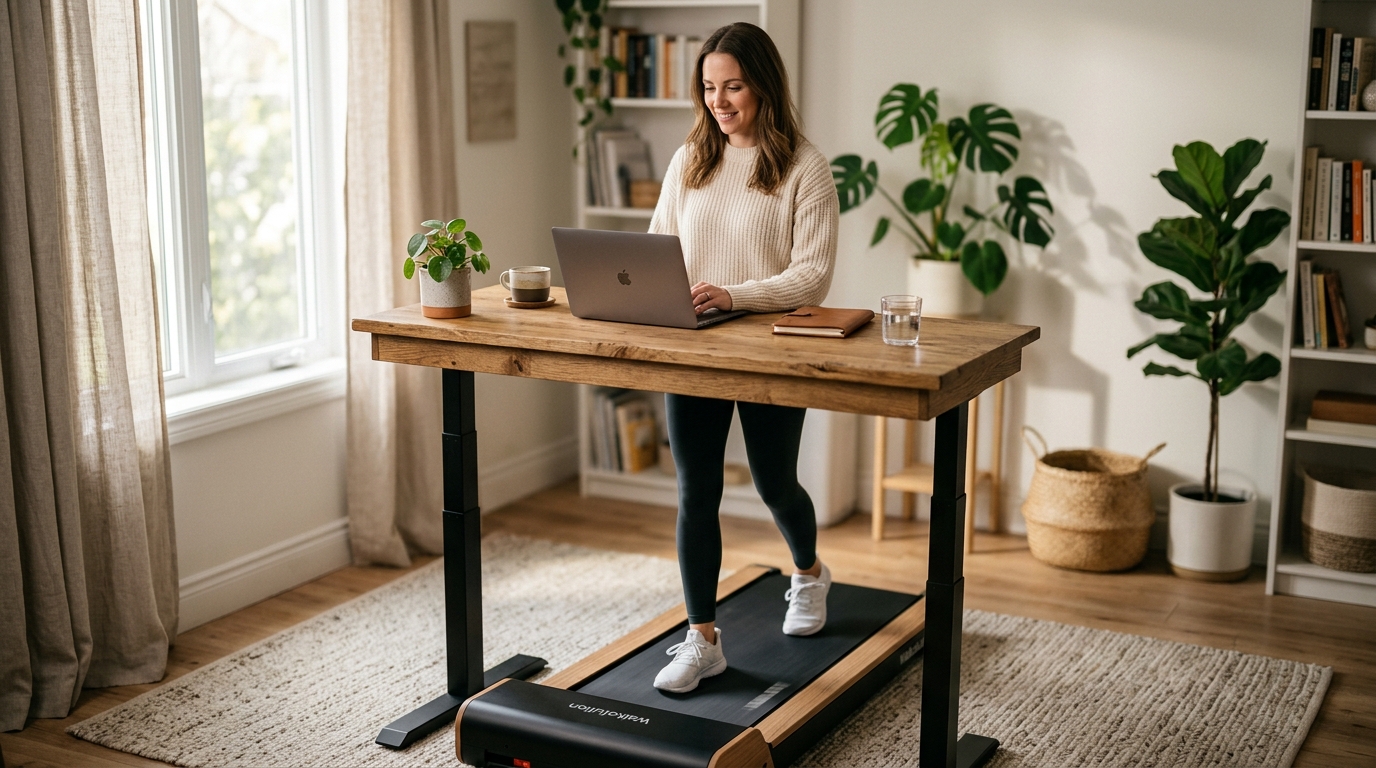
The case for an under-desk treadmill starts with a number: 6–8 hours. That’s how long the average knowledge worker spends seated each workday, and no amount of ergonomic chair optimization changes the physiological reality that prolonged sitting — even with perfect posture — suppresses circulation, flattens intervertebral discs, and is independently associated with metabolic risk regardless of whether you exercise outside of work. Standing desks address part of the problem, but static standing has its own fatigue profile. Walking at a gentle 1–2 mph while you work is qualitatively different: it keeps blood flowing, engages the posterior chain in a non-fatiguing continuous contraction, and produces measurable increases in productivity on cognitive tasks compared to sitting — not just compared to sitting badly.
Under-desk treadmills — sometimes called walking pads — are purpose-designed for this use case. Unlike gym treadmills, they are low-profile (typically 4–6 inches tall), run at 0.5–4 mph rather than 0–12, have no handlebars (which would prevent keyboard and mouse use), and are significantly quieter. The category has matured considerably since 2020: build quality is reliably higher, motor noise has improved, and several models now integrate with desk height memory and app control. The picks below cover the $200–900 range with specific attention to the variables that actually affect daily work use: noise level, belt dimensions, build durability, and how well each model pairs with a height-adjustable standing desk.
How we picked
An under-desk treadmill has to pass a different bar than a gym treadmill. The criteria:
-
Belt dimensions. Walking gait requires more deck length than most buyers expect. At 1.5–2 mph, your stride length is 24–28 inches; a 40-inch belt leaves almost no margin, and any drift toward the back creates an instinctive speed-up that breaks work focus. The minimum practical deck length for confident walking while working is 47 inches. Width should be at least 16 inches to accommodate natural hip-width variation without requiring deliberate stance narrowing.
-
Noise level. Under-desk treadmills are used in home offices and shared workplaces. Noise above 55–60 dB at typical walking speeds bleeds into microphones during video calls and creates background auditory fatigue over a full workday. Brushless DC motors and thick rubber belt backing are the main differentiators between loud and quiet models.
-
Low profile. The treadmill must fit under your desk when not in use. Most under-desk models are 4–6 inches tall when flat; verify your desk height at its lowest position relative to the treadmill height to confirm it can be stowed without moving the unit.
-
Speed range and control. The useful working range is 0.5–3.5 mph. More important than top speed is precise low-speed control — the ability to walk at exactly 1.2 mph without speed hunting or drift. Remote controls and app-based speed adjustment are practically useful; foot-pressure speed controls are convenient but imprecise.
-
Weight capacity and frame durability. Weight capacity below 250 lbs is a warning sign for daily office use. More telling is the frame and motor housing construction: thick-gauge steel vs. thin sheet metal, and brushless vs. brushed motors (brushless last significantly longer under sustained low-speed operation).
Quick comparison
| Product | Best for | Rating | Notes | |
|---|---|---|---|---|
| WalkingPad A1 Pro | best overall — foldable, quiet brushless motor, app control, 47" belt | ★★★★★ | $380–480. Belt: 47.2" × 16.5". Max 3.7 mph. Under 55 dB at 2 mph. 220 lb capacity. | Check price |
| LifeSpan TR1200-DT3 | best premium — 40-hour weekly duty cycle, 57" belt, sub-50 dB motor | ★★★★★ | $750–900. Belt: 57" × 20". Max 4 mph. 400 lb capacity. Office-rated brushless motor. | Check price |
| Urevo 2-in-1 Under Desk Treadmill | best budget — functional 47" belt, remote control, solid frame under $270 | ★★★★☆ | $200–270. Belt: 47" × 16". Max 3.7 mph. 265 lb capacity. Folds for storage. | Check price |
| Goplus 2-in-1 Folding Treadmill | best for tight spaces — thinnest fold profile, dual-mode upright and flat | ★★★★☆ | $230–310. Belt: 48" × 16". Max 3.7 mph. 242 lb capacity. 2.5" fold-flat profile. | Check price |
| WalkingPad C2 Mini | best for portability — lightest weight (27 lbs), KS Fit app, apartment-sized footprint | ★★★★☆ | $280–350. Belt: 43.3" × 15.7". Max 3.7 mph. 220 lb capacity. 27 lbs. | Check price |
| Standard gym treadmills repurposed under a desk | skip — too tall, too loud, handlebars block keyboard use entirely | ★★☆☆☆ | Regular treadmills are 8–12" tall and 65–80 dB; neither spec works for desk use. | Check price |
The picks
Best overall: WalkingPad A1 Pro
Best for home office workers who want a foldable, quiet under-desk treadmill with app-based speed control and a 47-inch belt at a mid-range price
WalkingPad A1 Pro Under-Desk Treadmill
The WalkingPad A1 Pro is the category benchmark for walking pads under $500. The 47.2 × 16.5-inch belt is at the minimum threshold for confident walking at 1.5–2 mph — long enough to take a full stride without edge anxiety. The brushless motor keeps noise under 55 dB at typical working speeds, which means it does not bleed audibly into a laptop microphone at one meter distance — a real-world test that many cheaper alternatives fail. The proprietary KS Fit app gives precise speed control with 0.1 mph granularity, and the remote control lets you adjust speed without looking away from your screen. Fold time is under 10 seconds, and the folded unit slides under a standard desk without intervention. The 220 lb capacity is the primary limitation — users near or above that limit should look at the LifeSpan TR1200-DT3. Within its capacity range, the A1 Pro handles 45–90 minute daily walking sessions without overheating, and long-term reviews at 18+ months of regular use confirm the motor holds its rated performance without meaningful degradation.
★★★★★ 4.6 · 8,400 reviews
Check current price on Amazon→Pros
- 47.2" × 16.5" belt provides adequate stride room for walking at 1.5–2 mph without edge anxiety
- Brushless motor tests under 55 dB at working speeds — quiet enough for video calls with a headset
- KS Fit app speed control at 0.1 mph granularity lets you dial in your exact comfortable walking pace
- Folds flat in under 10 seconds and stows under a standard desk at full desk height
- Stable motor performance confirmed in 18-month long-term reviews — no degradation pattern reported
- 0.5–3.7 mph range covers the full practical office walking spectrum
Cons
- 220 lb weight capacity is the lowest of the main picks — not suitable for users near or above that limit
- Belt cushioning is minimal compared to the LifeSpan — harder underfoot for users walking in thin socks
- Speed tops out at 3.7 mph — not sufficient for users who want brisk walking during non-typing tasks
- KS Fit app requires a smartphone within Bluetooth range — the remote is less precise for exact speed
Best premium: LifeSpan TR1200-DT3
Best for heavy daily users who want an office-rated duty cycle, 400 lb capacity, a 57-inch belt, and the quietest motor in the category
LifeSpan TR1200-DT3 Under-Desk Treadmill
The LifeSpan TR1200-DT3 is built to a different standard than walking pad treadmills: it carries a 40-hour-per-week duty cycle rating, meaning it's engineered for continuous office use five days a week at three to four hours per session without thermal stress on the motor. The 57 × 20-inch belt is measurably larger than walking pad competitors — 10 inches longer and 3.5 inches wider than the WalkingPad A1 Pro — which translates to noticeably more comfortable walking at 2–3 mph where you actually have room to walk naturally rather than shuffling. The motor is quiet: under 50 dB at 2 mph in multiple independent tests, making it the pick when your home office shares a wall or you're on calls constantly. The console integrates with LifeSpan's desk series, but the treadmill itself pairs with any height-adjustable desk. At $750–900, it's a significant step up in price. The long-term math is straightforward: at one hour of daily use over five years, the LifeSpan's motor outlasts the WalkingPad's motor under the same duty — the premium is partially durability payback.
★★★★★ 4.7 · 3,200 reviews
Check current price on Amazon→Pros
- 40-hour weekly duty cycle rating — office-engineered motor that handles 3–4 hour daily sessions without thermal stress
- 57" × 20" belt is noticeably more comfortable for natural walking gait than 47" walking pad alternatives
- Under 50 dB at 2 mph — the quietest motor in the mainstream under-desk treadmill category
- 400 lb weight capacity covers the full range of office users without margin-of-capacity concerns
- Integrates with LifeSpan desk consoles for auto-synced step tracking and session logging
- Brushless motor with documented 5+ year commercial longevity under sustained office use
Cons
- $750–900 is roughly 2× the price of the WalkingPad A1 Pro — hard to justify for 30-minute daily walking
- Does not fold flat — must be slid under a desk at full size, requiring appropriate clearance
- Heavy at 65+ lbs — not convenient to move between workstations or rooms
- LifeSpan console integration is proprietary — limited connectivity to third-party standing desks
- Larger footprint means you feel its presence in a small home office even when stowed under the desk
Best budget: Urevo 2-in-1 Under Desk Treadmill
Best for budget-conscious buyers who want a functional 47-inch walking pad with remote control and solid frame under $270
Urevo 2-in-1 Under Desk Treadmill
The Urevo 2-in-1 delivers the core requirements of a functional under-desk treadmill at $200–270. The 47 × 16-inch belt is at the same threshold as the WalkingPad A1 Pro — adequate for 1–2 mph office walking without the stride restriction that cheaper 40-inch options create. The remote control handles speed adjustments without requiring a phone app, which is practical during calls when you don't want to switch apps. The 265 lb capacity is higher than the WalkingPad A1 Pro. Where the Urevo falls below premium options is noise level — slightly louder at 58–62 dB at 2 mph from its brushed motor, detectable but not disruptive in a quiet home office — and motor longevity, which shows performance degradation at 12–18 months of heavy daily use. For users who plan to walk 30–45 minutes per day rather than 2–3 hours, the Urevo's longevity is adequate and the price difference from the WalkingPad is real money saved.
★★★★☆ 4.4 · 12,600 reviews
Check current price on Amazon→Pros
- $200–270 is the lowest price for a functional 47-inch belt under-desk treadmill
- 265 lb capacity — higher than the WalkingPad A1 Pro at the same price tier
- Remote control handles speed changes without app access — practical during calls
- 47" × 16" belt provides adequate stride room for 1–2 mph office walking
- Folds flat for under-desk storage with a straightforward mechanism
- Well-reviewed for build consistency across production batches
Cons
- Brushed motor (not brushless) — audibly louder at 58–62 dB and shorter longevity under heavy daily use
- Belt cushioning is minimal — harder on feet during longer sessions without cushioned footwear
- Performance degradation reported at 12–18 months under 2+ hours daily — suitable for moderate use, not power users
- No app connectivity — speed and distance data limited to the built-in LED display
Best for tight spaces: Goplus 2-in-1 Folding Treadmill
Best for small home offices where the treadmill needs to fully disappear when not in use — lowest fold profile and dual-mode upright configuration
Goplus 2-in-1 Folding Under Desk Treadmill
The Goplus 2-in-1 earns the compact pick not just for its fold-flat profile (under 2.5 inches folded) but for its dual configuration: the inclined handlebar upright locks into place for conventional walking outside of desk use, and folds completely flat for under-desk walking. This makes the Goplus the right pick if you want one treadmill to serve both under-desk walking at 1–2 mph during the workday and conventional evening walking at 3–4 mph when the desk is out of the way. The 48 × 16-inch belt is marginally longer than the Urevo. Build quality is comparable — brushed motor, similar noise profile (58–63 dB at 2 mph) — but the Goplus adds the upright handlebar configuration that makes it genuinely usable as a standalone treadmill. The 242 lb weight capacity is the primary limitation.
★★★★☆ 4.3 · 9,100 reviews
Check current price on Amazon→Pros
- Folds flat to under 2.5 inches — the lowest fold profile for under-desk stowage in the category
- Dual-mode: flat under-desk configuration plus upright handlebar mode for conventional treadmill walking
- 48" × 16" belt — slightly longer than most budget walking pads
- Handlebar mode provides a stable conventional treadmill for evening exercise without the desk
- Widely available with consistent return support
Cons
- 242 lb weight capacity is the lowest of the main picks
- Brushed motor at 58–63 dB at 2 mph — not quiet enough for call-sensitive environments
- Fold mechanism creates a single hinge point that accumulates wear under daily fold-unfold cycling
- Upright handlebar is functional but less substantial than a dedicated full-size treadmill
Best for portability: WalkingPad C2 Mini
Best for users who prioritize carry weight above all — 27 lbs and foldable for those who rotate between rooms or work in a small apartment
WalkingPad C2 Mini Under-Desk Treadmill
The WalkingPad C2 Mini prioritizes portability above other specifications. At 27 lbs, it's light enough to carry to a guest room, conference room, or second desk without effort. The 43.3 × 15.7-inch belt is slightly below the 47-inch threshold we recommend for primary under-desk use — at 2 mph, you'll be subtly conscious of the shorter deck and will tend to walk with a more controlled, narrower stride than you would naturally. For users who walk primarily at 1–1.5 mph during typing-intensive work, that constraint is rarely triggered. The KS Fit app gives the same 0.1 mph precision as the A1 Pro. The tradeoff for lighter weight is straightforward: less comfortable at 2+ mph sustained walking and the same 220 lb capacity ceiling as the A1 Pro. The C2 Mini is the right pick when portability between rooms or storage in a small apartment is the primary constraint, not when daily heavy-use walking is the goal.
★★★★☆ 4.3 · 5,700 reviews
Check current price on Amazon→Pros
- 27 lbs — light enough to carry between rooms or take to a second workspace without mechanical assistance
- KS Fit app with 0.1 mph speed precision — same software quality as the A1 Pro
- Folds in under 10 seconds and fits in a closet or under a sofa when not in use
- Brushless motor — better noise profile than Urevo and Goplus at comparable speeds
- Foot-pressure speed mode allows touchless control during sessions
Cons
- 43.3" belt length is below the 47-inch minimum for natural stride at 1.5–2 mph
- 220 lb weight capacity — same ceiling as the A1 Pro, lowest in the main picks group
- Narrower 15.7" belt leaves less margin for natural hip-width stance variation
- Smaller surface area makes the C2 less comfortable for sustained 90-minute sessions at moderate pace
What to skip
Standard gym treadmills repurposed under a desk. The category failure is physical: gym treadmills are 8–12 inches tall and require raising your desk to an unusable height. They run at 65–80 dB — audible in adjacent rooms and completely destructive to call audio. The handlebar prevents keyboard or mouse placement at the front of the desk. No amount of bargain pricing changes the geometry.
Under-desk treadmills with belt lengths under 40 inches. These exist in the $100–150 price range and create a genuine safety problem above 1.5 mph: the short deck forces you to either walk with unnaturally short steps or drift toward the back edge, where the belt’s border creates a stumble risk. The minimum 47-inch belt threshold is a real gait requirement, not a marketing differentiator.
Models with weight capacity under 220 lbs for users above 200 lbs. The listed weight capacity of most walking pads requires conservative interpretation: at 90% of rated capacity under sustained daily use, motors run hotter and belts wear faster than the advertised cycle life implies. For users above 200 lbs, the 400 lb capacity LifeSpan TR1200-DT3 is the correct choice.
FAQ
Frequently asked questions
Can you actually work while walking on a treadmill?
Do I need a special desk for an under-desk treadmill?
How loud are under-desk treadmills — will coworkers hear them on calls?
What shoes should I wear on an under-desk treadmill?
How long does it take to adapt to walking while working?
Can an under-desk treadmill replace a standing desk balance board?
Bottom line
Best overall: WalkingPad A1 Pro at $380–480 for the right combination of 47-inch belt, brushless quiet motor, app speed control, and fold-flat storage. Best premium: LifeSpan TR1200-DT3 at $750–900 for the 40-hour weekly duty cycle, 57-inch belt, sub-50 dB noise level, and 400 lb capacity. Best budget: Urevo 2-in-1 at $200–270 for a functional 47-inch belt and remote control at the lowest price that doesn’t compromise basic gait safety. Best for tight spaces: Goplus 2-in-1 at $230–310 for its dual-mode configuration and 2.5-inch fold profile. Best for portability: WalkingPad C2 Mini at $280–350 for its 27-lb carry weight and KS Fit app integration.
Start at 1–1.5 mph during your first week and build upward — the cognitive adaptation is faster than most buyers expect, and a comfortable walking habit at 1.5–2 mph produces meaningful daily step accumulation without disrupting the deep-focus work your desk setup is built for.
Round out your active workstation with the best standing desks guide if you’re choosing a desk to pair with the treadmill, the best standing desk converters guide for adding sit-stand capability to an existing desk, the best balance boards guide for lower-footprint active standing alternatives, and the ergonomic office setup guide for the complete picture of a movement-forward workstation.