guides
Standing Desk vs Treadmill Desk: Which Is Better?
Both cut the risks of all-day sitting, but they suit different workers. Here is what the research says and how to choose.
 Daniel Osei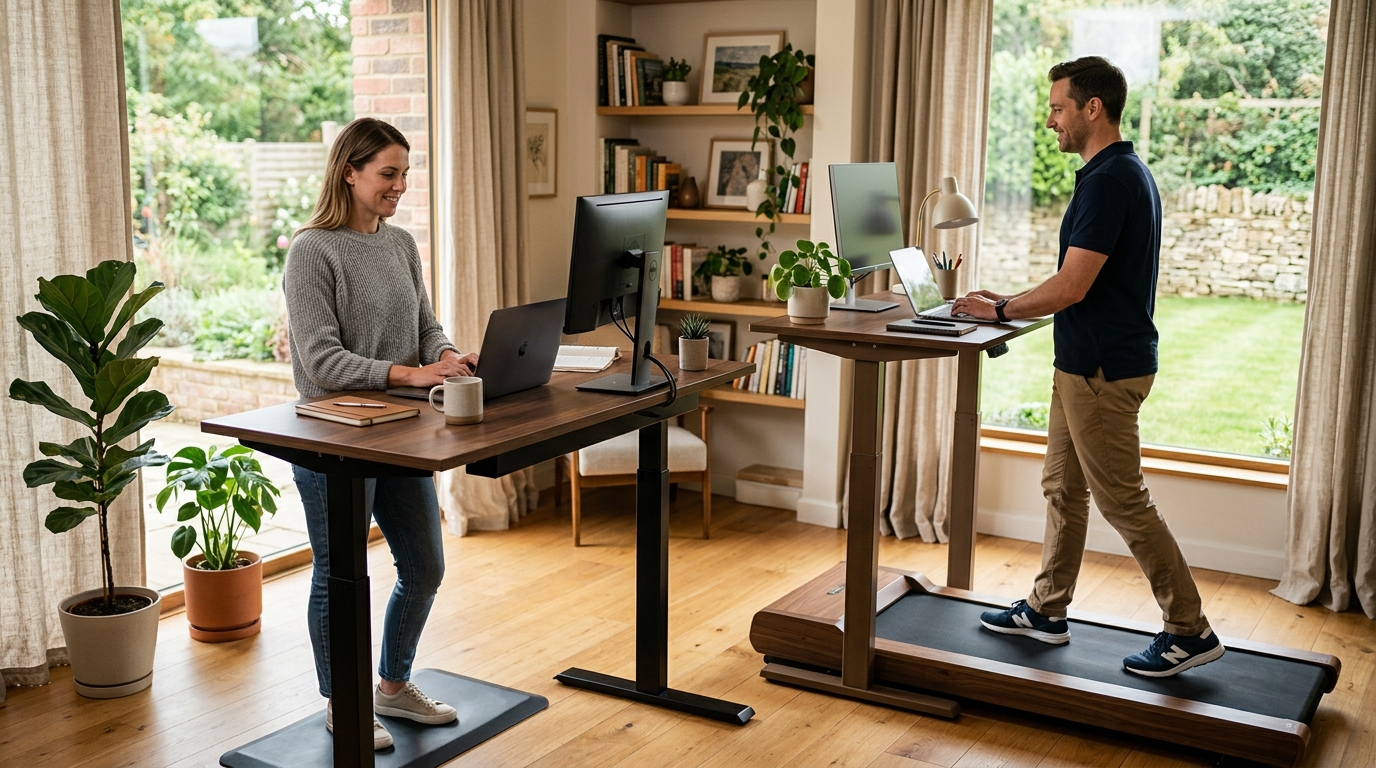
The verdict: A standing desk is the better default for most home office workers — lower cost, no learning curve, and documented back-pain benefits when used to alternate between sitting and standing. A treadmill desk burns far more calories and fights sedentary metabolic risk more aggressively, but it costs more, requires a height-adjustable desk, and has a real typing adjustment period.
What is a treadmill desk and how does it work?
A treadmill desk combines an under-desk walking pad — a low-profile, handlebar-free treadmill designed to run at 0.5 to 4 mph — with a height-adjustable standing desk raised to walking height, typically 2 to 4 inches higher than your normal standing desk position. Unlike gym treadmills, under-desk models are 4 to 6 inches tall when flat, run quietly enough (under 55 dB at 2 mph on quality units) to avoid interfering with microphones on video calls, and have no side rails that would block keyboard and mouse use.
The walking range used while working is narrow: most users settle at 1 to 2 mph, which is slow enough to maintain a stable typing posture and hold a normal conversation. At this pace, the motion functions less like exercise and more like a continuous gentle movement — it keeps blood flowing and blood sugar stable without demanding the cardiovascular attention that would prevent focused work.
Under-desk treadmills have been around since the 2000s, but the category matured significantly post-2020. Modern walking pads are meaningfully quieter, thinner, and better built than the first generation, with brushless DC motors that handle years of sustained low-speed operation without motor wear issues.
What is a standing desk and how does it differ?
A height-adjustable electric sit-stand desk raises your work surface to standing height so you can alternate between sitting and standing throughout the day. Unlike a treadmill desk, it requires no adaptation period, no pairing with an additional device, and no minimum desk height. You buy one piece of furniture that replaces your existing desk and gives you two stable postures.
The mechanism of benefit is different. A standing desk primarily interrupts prolonged sitting, which reduces lumbar disc compression, lowers back and neck pain, and breaks the metabolic risk window that uninterrupted sitting opens. The CDC evaluated 24 call-center workers in 2011 and found those using sit-stand desks reported 54% less upper-back and neck pain over four weeks. A standing desk does not meaningfully increase calorie burn or cardiovascular output relative to sitting — that is the job of the treadmill desk.
Standing desk vs treadmill desk: side-by-side comparison
| Product | Best for | Rating | Notes | |
|---|---|---|---|---|
| Upfront cost | Standing desk | ★★★★★ | A quality height-adjustable desk costs $400-900. Adding a walking pad costs $300-900 more, putting the total treadmill desk setup at $700-1,800 combined. | Check price |
| Calorie burn | Treadmill desk | ★★★★★ | Walking at 2 mph burns 200-300 calories per hour. Standing burns about 8-10 extra calories per hour versus sitting — the difference is dramatic. | Check price |
| Learning curve | Standing desk | ★★★★★ | Standing while working requires zero adjustment. Typing accurately while walking takes most users 2-4 weeks of daily practice to normalize. | Check price |
| Back pain relief | Standing desk | ★★★★☆ | Both interrupt prolonged sitting and reduce lumbar compression. The standing desk has a larger body of research behind it for back pain outcomes. | Check price |
| Cardiovascular benefit | Treadmill desk | ★★★★★ | Walking 2-3 hours per day at 1.5 mph produces measurable improvements in blood sugar, triglycerides, and resting heart rate. Static standing does not. | Check price |
| Deep-focus work | Standing desk | ★★★★☆ | Standing is fully compatible with complex writing, coding, and analysis. Walking while typing demands more mental bandwidth and slows output for most tasks. | Check price |
| Calls and light tasks | Treadmill desk | ★★★★☆ | Most users find 1-1.5 mph compatible with all-hands calls, email review, and reading tasks once the initial adaptation period is over. | Check price |
| Space required | Standing desk | ★★★★☆ | A standing desk replaces an existing desk. A treadmill desk adds a walking pad footprint — roughly 24 x 55 inches — under the desk when in use. | Check price |
| Noise during calls | Standing desk | ★★★★★ | A standing desk is completely silent. Quality under-desk treadmills run at 45-55 dB at 2 mph; budget models can exceed 60 dB and register on microphones. | Check price |
How many calories does a treadmill desk actually burn?
This is where the two options diverge most sharply. Walking at 2 mph burns approximately 200 to 300 calories per hour depending on body weight — a 160 lb person burns roughly 230 calories per hour at that pace. Across a 2-hour treadmill session during an 8-hour workday, that is 400 to 500 additional calories. Over a year of consistent use, that adds up to 20,000 to 40,000 extra calories — a figure that translates to meaningful metabolic benefit.
Standing, by comparison, burns approximately 8 to 10 more calories per hour than sitting. A 2016 meta-analysis in the European Journal of Preventive Cardiology calculated the calorie difference at 0.15 kcal per minute — roughly 9 extra calories per hour. Even at 4 hours of standing per day, that is only 36 additional calories.
The gap is not close. If calorie burn and metabolic health are your primary motivation, a treadmill desk delivers 10 to 15 times the caloric benefit of a standing desk at typical usage levels. If back pain relief and postural variety are the primary goal, the standing desk achieves those outcomes at a fraction of the cost.
Can you actually focus while walking on a treadmill desk?
This is the practical question most reviews gloss over. The research is nuanced.
A 2018 study in Computers in Human Behavior found that walking at 1.5 mph had no significant effect on typing accuracy compared to sitting — but only in participants who had practiced walking while typing for at least 3 weeks beforehand. In naive users, typing speed dropped 10 to 15% and error rates increased noticeably.
Task type matters considerably. Studies consistently find walking at 1 to 2 mph is compatible with:
- Listening tasks — meetings, podcasts, webinars, video calls where you are not the primary presenter
- Reading — reviewing documents, catching up on articles, reading research without heavy annotation
- Email — inbox triage, reply drafting for routine correspondence
- Data entry — rhythmic, low-cognitive-demand keyboard work
Walking at treadmill speeds is less compatible with:
- Complex writing where every word requires deliberate choice — long-form articles, technical documentation, proposals
- Code review and debugging that requires tracking multiple state changes and logic paths
- Mathematical or financial modeling with dense formula editing
- Rapid mouse-and-keyboard switching — design work, video editing, anything that requires precise cursor control under time pressure
Most experienced treadmill desk users describe a natural task-pairing habit that emerges after the first month: they walk during calls and easy email, sit for focused writing and coding, and stand for moderate-concentration tasks like reviewing documents. This mirrors how sit-stand desk users naturally split postures — the treadmill simply adds a third option.
The adaptation period is real but finite. Most people report reaching comfortable 1.5 to 2 mph typing accuracy within 2 to 4 weeks of daily 30-minute practice sessions.
Who should choose a standing desk?
A height-adjustable sit-stand desk is the right default for most home office workers. It makes sense if:
- Back pain from prolonged sitting is your primary problem — the standing desk has the strongest research backing for this specific outcome
- Your work requires long uninterrupted focus blocks — writing, coding, analysis that does not benefit from a movement layer during the session
- You are setting up a complete desk from scratch — it replaces your existing desk entirely and can pair with a treadmill later if you choose to add one
- Budget is under $700 — a quality standalone sit-stand desk is achievable at $400 to $600; a treadmill desk setup is not
- You share a space with others — a standing desk is completely silent; a treadmill introduces noise and a different visual profile during video calls
Who should choose a treadmill desk?
A treadmill desk setup — a walking pad plus height-adjustable desk — makes sense if:
- Calorie burn and cardiovascular health are your primary goals, not just back pain relief
- Your workday is heavily meeting- and call-based — you spend 2 to 4 hours on calls where you can walk without cognitive penalty
- You already own a height-adjustable desk — adding a walking pad to an existing sit-stand desk is the lowest-friction entry point, since the desk cost is already sunk
- You have the floor space — under-desk treadmills require roughly 24 x 55 inches and cannot be used with fixed-height desks
- You will commit to the adaptation period — users who try to walk at full speed during complex work tasks on day one and give up are a documented failure mode in this category
Recommended products
Best standing desk: Flexispot E7 Pro
Best for Best value height-adjustable sit-stand desk for most home offices
Flexispot E7 Pro Electric Standing Desk
The Flexispot E7 Pro is the most consistently recommended height-adjustable desk in the under $700 range. Dual motors give it a 355 lb weight capacity and noticeably better lateral stability at standing height than single-motor competitors — important if you have a large monitor or dual-display setup. Height range of 22.8 to 48.4 inches covers users from 4ft 8in to 6ft 5in. Four memory presets mean one press switches between your sitting and standing heights. The 15-year frame warranty is among the strongest at this price. Available in widths from 48 inches to 80 inches for corner and wide setups.
★★★★★ 5.0 · 12,400 reviews
Check current price on Amazon→Pros
- Dual-motor drive delivers noticeably better stability at standing height than single-motor desks
- Height range from 22.8 to 48.4 inches covers users from 4ft 8in to 6ft 5in
- 15-year frame warranty is among the strongest in the category at this price point
- Available in 48-inch to 80-inch widths including L-shaped and corner configurations
Cons
- Assembly takes 45-60 minutes and the tabletop attachment step is easier with two people
- Ships at over 100 lbs total; getting the boxes to an upstairs home office takes planning
Best budget treadmill desk: WalkingPad A1 Pro
Best for Best overall walking pad for home offices — quiet brushless motor, 47-inch belt, foldable in 10 seconds
WalkingPad A1 Pro Under-Desk Treadmill
The WalkingPad A1 Pro is the category benchmark for walking pads under $500. The 47.2 x 16.5-inch belt is at the practical minimum for confident walking at 1.5 to 2 mph — long enough for a full stride without edge anxiety. The brushless motor runs under 55 dB at typical working speeds, which means it does not register audibly on a laptop microphone at 1 meter distance. The KS Fit app gives speed control at 0.1 mph granularity so you can dial in your exact comfortable pace without looking away from the screen. Folds flat in under 10 seconds and stows under any standard height-adjustable desk. Requires a desk that can reach at least 45 to 47 inches for walking posture.
★★★★★ 4.6 · 8,400 reviews
Check current price on Amazon→Pros
- Brushless motor runs under 55 dB at 2 mph — quiet enough for video calls with a headset
- KS Fit app speed control at 0.1 mph granularity lets you dial in your exact working pace
- Folds flat in under 10 seconds for easy stowing under the desk between walking sessions
- 47.2-inch belt provides adequate stride room at 1.5 to 2 mph working speeds
Cons
- 220 lb weight capacity is the lowest in its price range — users near that limit should step up to the LifeSpan TR1200-DT3
- Belt width of 16.5 inches can feel narrow for users with a wider than average natural gait
Best premium treadmill desk: LifeSpan TR1200-DT3
Best for Best premium walking pad for daily heavy use — 57-inch belt, 400 lb capacity, commercial-grade motor
LifeSpan TR1200-DT3 Under-Desk Treadmill
The LifeSpan TR1200-DT3 is the treadmill desk for users who will walk 4 to 6 hours per day. The 57 x 20-inch belt is the widest and longest in the under-desk category, eliminating any edge anxiety at normal walking strides. The brushless motor carries a 40-hour weekly duty cycle rating — a commercial-grade specification that no consumer walking pad matches. It runs under 50 dB at all working speeds, the quietest motor in the category. The 400 lb weight capacity covers essentially all users. If you are building a treadmill desk setup you intend to use seriously for years without maintenance concerns, this is the one to buy.
★★★★★ 4.7 · 3,200 reviews
Check current price on Amazon→Pros
- 57 x 20-inch belt is the widest and longest in the category — zero edge anxiety at any stride length
- Rated for 40 hours per week of continuous use — commercial-grade duty cycle for serious daily users
- Under 50 dB at all working speeds — the quietest brushless motor in the under-desk treadmill category
- 400 lb weight capacity with a robust frame construction built to match that specification
Cons
- Costs $750-900, which is $300-400 more than the WalkingPad A1 Pro for most buyers
- Does not fold and requires a dedicated under-desk footprint when not in use
What to skip
Fixed-height standing desks used as a treadmill desk base do not work. A walking pad requires the desk to reach at least 45 to 47 inches to accommodate walking posture — fixed desks cannot get there, so the combination forces a backward lean or slumped wrist angle that creates new problems.
Gym treadmills repurposed under a desk are a common impulse but a poor solution. Standard treadmills are 8 to 12 inches tall, raising the effective floor height and forcing you to stand awkwardly high relative to the desk surface. Motor noise runs 60 to 80 dB — loud enough to make video calls impossible and to create auditory fatigue over a full workday. The side handlebars block natural arm positioning entirely.
Budget walking pads under $200 consistently fail on two critical metrics: belt length (typically 39 to 42 inches, which is too short for a confident stride at 1.5 mph and causes edge anxiety) and motor noise (typically 60 dB or above, which bleeds into microphones and creates call problems). The WalkingPad A1 Pro at $380 to $480 is the realistic floor for a walking pad that passes both thresholds.
A treadmill desk as your first ergonomic investment is a sequencing mistake. If you do not own a height-adjustable desk and are starting fresh, buy the desk first. The standing desk delivers immediate back-pain benefit and can be used indefinitely without a treadmill; the walking pad is unusable without the desk beneath it and adds significant cost upfront.
FAQ
Frequently asked questions
Can you type normally on a treadmill desk?
Do you need a special desk to use an under-desk treadmill?
How loud are under-desk treadmills during calls?
Is a treadmill desk worth the cost over a standing desk?
How long should you walk on a treadmill desk each day?
What speed should I use on a treadmill desk?
Bottom line
A standing desk is the right starting point for most home office workers. It addresses the primary ergonomic problem — prolonged uninterrupted sitting — at a fraction of the cost of a treadmill desk setup, with zero adaptation period and no noise during calls. The Flexispot E7 Pro at around $600 is the best-value entry point.
A treadmill desk setup earns its premium if cardiovascular health and calorie burn are meaningful goals, and if your workday includes enough meeting and call time to walk without sacrificing focused-work output. The WalkingPad A1 Pro paired with any quality height-adjustable desk is the most practical combination for most home offices.
For chair recommendations that pair with either setup, see best ergonomic chairs for back pain. For research on the broader standing desk question, see sitting vs standing desk: what the evidence shows. If you are adding a treadmill to an existing desk, see best under-desk treadmills. For the complete desk buying guide, see best standing desks.