guides
Standing Desk Mat vs Footrest: Which Do You Need?
Anti-fatigue mats reduce standing fatigue; footrests support seated posture. Here is how to pick the right one — or both — for your setup.
 Daniel Osei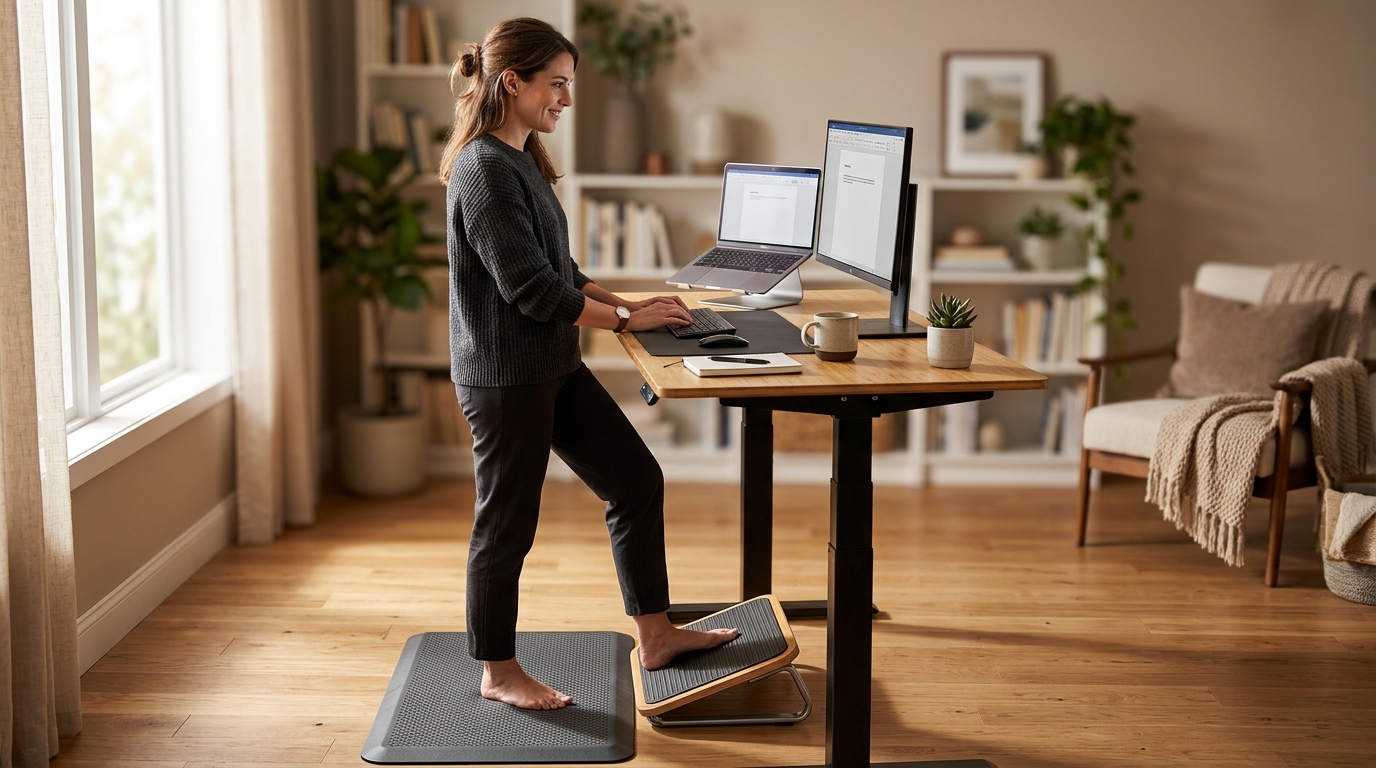
The verdict: Anti-fatigue mats reduce foot and leg fatigue while you are standing; footrests support circulation and lower-back posture while you are seated. They solve different problems for different postures. If you stand more than 2 hours a day, get a mat first. If your feet do not rest flat on the floor while seated, get a footrest first. Most sit-stand desk users benefit from having both.
What is an anti-fatigue standing desk mat?
An anti-fatigue mat is a cushioned foam or gel pad placed on the floor beneath a standing workstation. The material compresses slightly under your weight, which activates small, continuous muscle contractions in your feet, calves, and thighs. These micro-movements improve circulation, reduce lactic acid buildup, and relieve the static compression that makes prolonged standing painful on hard floors.
Most anti-fatigue mats fall into two categories: flat and contoured. Flat mats are simpler — a rectangle of foam or gel that provides cushioning and a slight give underfoot. Contoured mats (like the Topo by Ergodriven or the Kangaroo Pro) add raised ridges, slopes, and a central dome that encourage you to shift your weight and stance while standing. Research consistently shows that contoured mats outperform flat mats because they stimulate more micro-movement rather than just cushioning a static stance.
Effective anti-fatigue mats cost $40 to $130. Below that range, the foam compresses permanently within weeks and stops providing meaningful cushioning. Above $130, the returns diminish quickly.
What is an ergonomic footrest?
A footrest is a raised platform that sits beneath your desk and supports your feet while you are seated. The goal is to let you maintain a comfortable knee angle (90-110 degrees) and keep blood flowing through your lower legs even when your chair height does not allow your feet to rest flat on the floor.
Footrests are also useful for taller workers who need to raise their chair to reach the correct elbow-to-desk height, which lifts their feet off the floor entirely. Rather than dropping the chair and compromising arm angle, a footrest fills the gap.
Designs range from flat platforms ($20-40) to angled or rocking models ($50-100) that encourage foot movement and ankle rotation. Rocking and angling footrests — like the ErgoFoam adjustable model — provide circulation benefits similar to anti-fatigue mats in that they prevent fully static foot positioning while seated.
Standing desk mat vs footrest: key differences
| Product | Best for | Rating | Notes | |
|---|---|---|---|---|
| Primary use posture | Different postures | ★★★☆☆ | Anti-fatigue mats are used while standing; footrests are used while sitting. They do not overlap in function — they complement each other. | — |
| Core benefit | Anti-fatigue mat | ★★★★☆ | Mats address standing fatigue and lower-limb discomfort. Footrests address seated circulation and knee-to-hip angle when feet cannot reach the floor flat. | — |
| Who benefits most | Footrest | ★★★★☆ | Shorter users and anyone who raises their chair to match desk height will see the most dramatic benefit from a footrest. Mats benefit everyone who stands 1 or more hours per day. | — |
| Cost | Footrest | ★★★★☆ | Quality footrests cost $30-80. Quality anti-fatigue mats cost $40-130. Both are low-cost ergonomic investments with high impact per dollar. | — |
| Portability | Footrest | ★★★★☆ | Footrests are typically lighter and easier to move under or away from a desk. Anti-fatigue mats stay in a fixed zone in front of the standing-height workstation. | — |
| Pairing with a sit-stand desk | Both | ★★★★★ | Sit-stand desk users benefit from both: the mat covers standing intervals, the footrest covers seated intervals. Prioritize the mat if you stand more; the footrest if you sit more. | — |
| Setup and maintenance | Footrest | ★★★☆☆ | Both require no installation. Anti-fatigue mats should be inspected every 12-18 months and replaced when they lose their spring. Footrests typically last 5-10 years with normal use. | — |
When should you choose a standing desk mat first?
Get an anti-fatigue mat if any of these apply to you:
- You stand at your workstation for 1 hour or more per day. Below that threshold, the difference between a mat and a hard floor is relatively small. Above it, the impact on fatigue is significant.
- You have a height-adjustable desk and have started building your standing time. Standing on hard tile or hardwood for 30-minute intervals without a mat causes heel and calf discomfort that pushes many users back to sitting permanently. A good mat removes that friction.
- You experience foot or lower-leg fatigue after standing sessions. This is the clearest signal that the floor surface is causing problems.
- Your workspace has hard flooring — tile, hardwood, or concrete. Carpeted offices provide some natural cushioning; hard floors do not.
Standing desk mats are also one of the cheapest ergonomic upgrades available relative to their impact. A $60 mat used consistently for 2 hours a day will make more difference to your daily comfort than many more expensive ergonomic accessories.
When should you choose a footrest first?
Get a footrest if any of these apply:
- Your feet do not rest flat on the floor when your chair is adjusted to the correct elbow-to-desk height. This is the most common footrest scenario. Raising your chair to get the right arm angle lifts your feet, and dangling feet cut off circulation at the back of the thigh.
- You are 5 feet 4 inches or shorter and use a standard-height desk (28-30 inches). At these heights, many users cannot simultaneously achieve correct arm angle and flat-footed floor contact. A footrest closes that gap.
- You notice tingling, numbness, or discomfort in your lower legs or feet after 30 or more minutes of sitting. This indicates restricted blood flow at the knee — a footrest that lets you shift your foot angle resolves most of this.
- You work long sitting sessions of 4 or more hours without a height-adjustable desk. Footrests reduce the postural stress of extended sitting more than most people expect.
When do you need both?
If you use a sit-stand desk and alternate between sitting and standing throughout the day — which is the evidence-based goal for desk workers — you will benefit from both accessories at some point.
In practice, most users who build to 40-50% standing time (the research-recommended target) find that a mat alone covers their first 6-12 months. As standing time increases and fatigue patterns shift, a footrest for seated intervals becomes noticeably valuable.
The transition between the two is straightforward. When you switch to standing, the footrest slides under the desk and the mat is in place. When you sit back down, you pull out the footrest and the mat stays where it is, out of the way. The combined cost of $80-180 for both is low relative to the impact on daily comfort across a full workday.
If budget only allows one purchase right now, match it to your current dominant posture.
The best anti-fatigue standing desk mats
Best for Best overall anti-fatigue mat for standing desks
Topo Comfort Mat by Ergodriven
The Topo is the most-recommended standing desk mat in the under-$100 category. The raised central dome, sloped edges, and multiple standing zones encourage constant subtle weight shifts that flat mats cannot replicate. Made from dense polyurethane foam that holds its shape after years of daily use. Available in three sizes — original, large, and mini for tighter workstations. The beveled edges eliminate the tripping hazard common on thicker flat mats. If you are buying one anti-fatigue mat for a sit-stand desk, this is the one.
★★★★★ 5.0
Check current price on Amazon→Pros
- Contoured surface encourages weight shifts that reduce fatigue better than flat foam
- Dense polyurethane foam holds its shape for years of daily use
- Available in three sizes to match different desk widths and workstation layouts
- Beveled edges eliminate the tripping hazard common on thicker flat mats
Cons
- Higher price than flat foam mats — typically $80-100 versus $30-50 for basic foam
- The contoured surface takes 2-3 days to feel natural if you are accustomed to flat mats
Best for Best value flat anti-fatigue mat for standing desks
Kangaroo Pro Standing Mat
The Kangaroo Pro is the best flat foam anti-fatigue mat for users who want straightforward cushioning without a contoured design. Three-quarter-inch thick pebbled foam provides genuine cushioning — it does not bottom out like cheaper options — and the beveled edges sit flush enough to avoid catching socks or slippers. A practical choice for users who wear supportive footwear while standing and want a no-fuss rectangular mat that covers their full standing zone at a lower price.
★★★★☆ 4.0
Check current price on Amazon→Pros
- Dense foam does not bottom out or permanently compress under daily use
- Lower price point than contoured mats — typically $45-60
- Large size options cover wide standing zones for multi-monitor setups
- Simple rectangular shape is easy to position and clean around
Cons
- Flat design does not encourage weight shifts the way contoured mats do
- Less comfortable barefoot over extended standing sessions than contoured surfaces
The best ergonomic footrests
Best for Best overall ergonomic footrest for desk use
ErgoFoam Adjustable Ergonomic Foot Rest
The ErgoFoam is the most consistently recommended footrest in the under-$60 category. Height is adjustable via a removable wedge — the base sits at 3.5 inches, the wedge raises it to 4.5 inches — so you can dial in the exact angle that works for your chair and desk combination. Dense memory foam provides firm-yet-cushioned support without bottoming out. A mesh cover keeps it cool and prevents sliding on hard floors. Works equally well on carpet and hard flooring.
★★★★★ 5.0
Check current price on Amazon→Pros
- Adjustable height via a removable wedge covers a wide range of chair and desk height combinations
- Dense memory foam provides firm support that does not flatten over time
- Mesh cover improves breathability and prevents the footrest from sliding on hard floors
- Under-$50 price makes it one of the best value ergonomic accessories available
Cons
- Fixed wedge angle means you cannot dynamically rock or tilt the footrest during use
- The cover is not machine-washable; spot-cleaning only
Best for Best rocking footrest for active seated use
Humanscale FM300 Foot Machine
The Humanscale FM300 adds a rocking motion that most static footrests lack. The platform pivots forward and back, encouraging ankle movement and lower-leg muscle activation while seated — similar in principle to what a contoured mat does for standing. Made from durable high-density plastic with a textured top surface. At around $80, it costs more than static foam footrests, but the active movement benefit justifies the price for users who spend 5 or more hours a day in a seated position.
★★★★☆ 4.0
Check current price on Amazon→Pros
- Rocking motion encourages ankle and lower-leg movement during long seated sessions
- Heavy-duty build quality designed for commercial office use — built to last
- Height adjustable across multiple positions to suit different desk and chair combinations
Cons
- Costs $70-90, roughly double the price of quality static foam footrests
- Rocking motion can feel distracting for users who prefer a stable, fixed foot platform
- Plastic construction is less comfortable barefoot than foam-topped options
What to skip
Cheap flat foam mats under $25 are the most common standing desk accessory mistake. The foam compresses permanently within 2-4 months of daily use, at which point the mat provides no more cushioning than the hard floor. Replacing a $25 mat every few months costs more over a year than buying a $60-80 mat once.
Thin plastic footrests in the $15-20 range often have fixed, non-adjustable heights that do not match your specific chair-to-desk combination. A footrest at the wrong height forces awkward ankle angles and can make leg discomfort worse rather than better. The height adjustment in the ErgoFoam is worth the extra cost.
Gel mats marketed as orthopedic often have a gel top layer bonded to low-density foam that loses its structure quickly. True gel mats — gel core throughout — are effective but expensive, generally $150 and up. In the $40-100 range, high-density polyurethane foam outperforms gel-layer designs in long-term durability.
Using a footrest while standing — placing a footrest on the floor in front of your anti-fatigue mat — is not an effective substitute for either product and creates an uneven surface that increases ankle roll risk.
FAQ
Frequently asked questions
Can I use a footrest instead of an anti-fatigue mat?
Do I need an anti-fatigue mat if I have carpet?
How thick should an anti-fatigue mat be?
Should I use a footrest if I have lower-back pain?
How often should I replace an anti-fatigue mat?
Can I use both a mat and a footrest at the same desk?
Bottom line
Anti-fatigue mats and footrests are not competing products — they are complementary accessories for the two postures you cycle between at a sit-stand desk. Choose first based on your dominant posture: if you stand more than 2 hours a day, start with the Topo by Ergodriven ($80-100) or the Kangaroo Pro ($45-60). If you sit most of the day with your feet not reaching the floor comfortably, start with the ErgoFoam adjustable footrest ($40-55). For active seated use, the Humanscale FM300 ($80) adds rocking foot movement. Most sit-stand desk users benefit from owning both once they build standing time past 40%.
For standing desk comparisons, see sitting vs standing desk: what the research says. For a full mat roundup, see best standing desk mats. For more footrest options, see best foot rests for desk workers. For your complete ergonomic setup, see how to set up an ergonomic workstation.