guides
Ergonomic Chair vs Kneeling Chair: Which Is Better?
Ergonomic chairs suit all-day use with full back support; kneeling chairs improve posture but work best for shorter sessions.
 Daniel Osei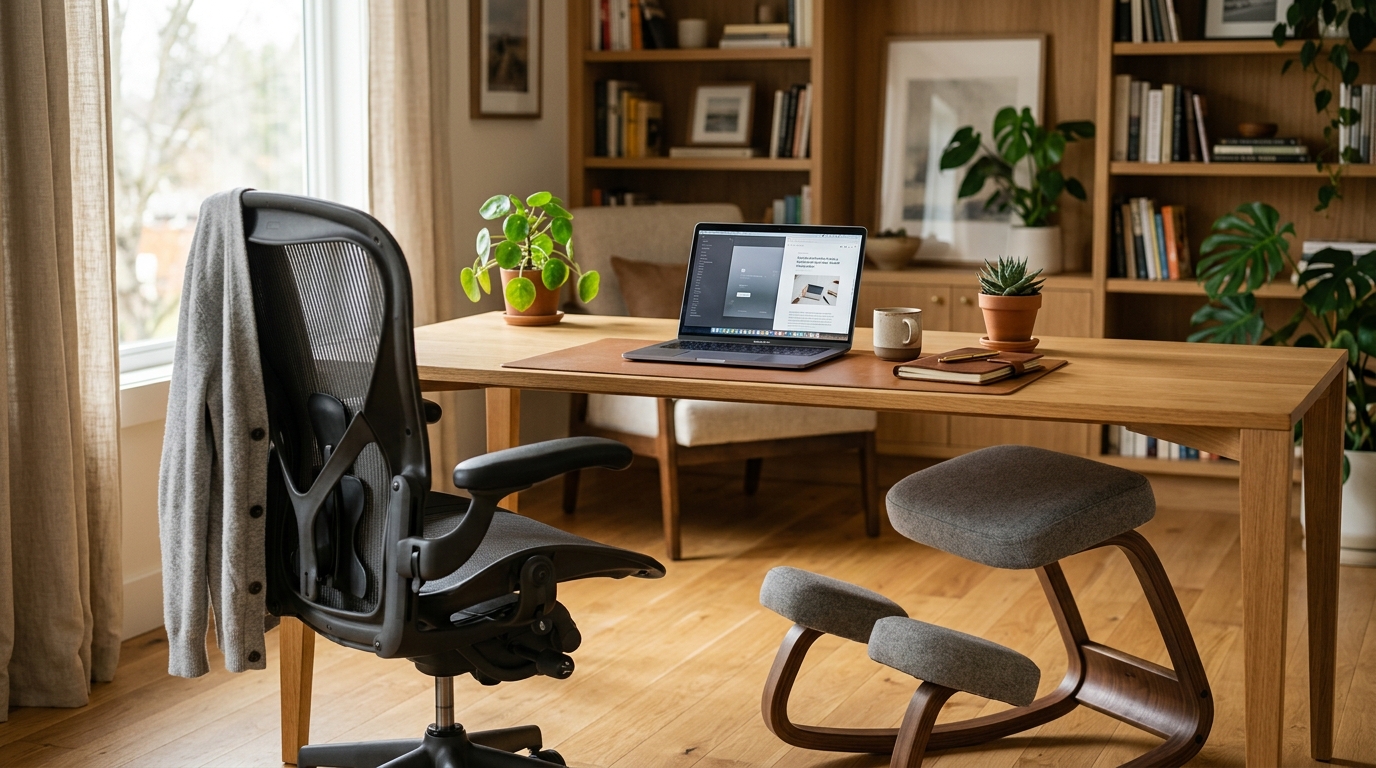
For most desk workers, a full ergonomic chair is the better choice. Ergonomic chairs provide back support for 6-10 hour days and suit virtually every body type and work style. Kneeling chairs can genuinely improve anterior pelvic tilt and core engagement for sessions of 1-3 hours, but they lack back support and become uncomfortable for all-day use.
Ergonomic chair vs kneeling chair: key differences at a glance
| Product | Best for | Rating | Notes | |
|---|---|---|---|---|
| All-day comfort | Ergonomic chair | ★★★★★ | Ergonomic chairs with full back support, seat depth adjustment, and armrests maintain comfort over 6-10 hour workdays. Kneeling chairs become uncomfortable in the knees and shins for most users after 60-90 minutes without a break. | — |
| Lumbar support | Ergonomic chair | ★★★★★ | A quality ergonomic chair provides adjustable lumbar support that fills the natural curve of the spine. Kneeling chairs rely on the tilted pelvis to maintain natural lumbar curve with no direct back support. | — |
| Hip angle and pelvic tilt | Kneeling chair | ★★★★★ | Kneeling chairs open the hip angle to 110-120 degrees versus the typical 90 degrees in a standard chair. This anterior pelvic tilt reduces pressure on the lumbar discs and encourages the spine to sit upright without muscular effort. | — |
| Core muscle engagement | Kneeling chair | ★★★★☆ | Without a back to lean on, kneeling chairs require active core engagement to maintain upright posture. Over weeks of use, this builds core endurance. However, fatigued users tend to slump forward rather than engage properly. | — |
| Knee and shin comfort | Ergonomic chair | ★★★★★ | Kneeling chairs shift 20-30% of body weight onto the shins and knees. This creates pressure point discomfort, especially on hard floors. Users with knee pain or poor circulation should avoid kneeling chairs entirely. | — |
| Adjustability | Ergonomic chair | ★★★★★ | Premium ergonomic chairs adjust seat height, depth, lumbar position, armrest height/width/depth, and tilt tension. Most kneeling chairs adjust only seat height, which also changes the shin pad angle simultaneously. | — |
| Price range | Kneeling chair | ★★★★☆ | Good kneeling chairs start at $80-200. High-quality ergonomic chairs start at $300-500 for mid-tier options and $800-1,800 for premium. Kneeling chairs are accessible at a much lower price point. | — |
Why ergonomic chairs work better for full workdays
The fundamental problem with a standard desk chair is that the 90-degree hip angle compresses the lumbar discs and encourages the pelvis to tilt posteriorly — rotating backward and flattening the natural lumbar curve. Most lower back pain at desks originates from this position sustained over hours.
A properly adjusted ergonomic chair addresses this with adjustable lumbar support that fills the lumbar curve, a seat depth that avoids pressing the front edge into the back of the thighs (which compresses leg circulation), and armrests that let the shoulders relax rather than hunch. When set up correctly, a quality ergonomic chair allows the spine to sit in its natural S-curve without continuous muscular effort to maintain it.
The key word is “correctly.” An ergonomic chair set at the wrong height or with lumbar support positioned above or below the lumbar vertebrae provides minimal benefit over a basic chair. If you have a good chair and still experience back pain, check the setup before blaming the chair.
For genuine all-day use, nothing currently beats a well-designed ergonomic chair from Herman Miller, Steelcase, or similar premium brands. The back support, seat depth adjustment, and customizable lumbar positioning give you a sustainable working posture that holds up across an entire workday without requiring active muscular effort to maintain.
Why kneeling chairs appeal to posture-conscious users
Kneeling chairs take a different approach: instead of supporting a neutral spine from behind, they create conditions for the spine to naturally align itself. The forward-sloping seat tilts the pelvis anteriorly (forward), which opens the hip angle from 90 degrees to 110-120 degrees. This decompresses the lumbar vertebrae and makes the spine tend toward its natural S-curve without a backrest providing the cue.
The result is that many users feel less lower back fatigue during focused short sessions. The spine is doing what it was designed to do — staying upright through alignment rather than passive back support. Some posture researchers and physical therapists recommend kneeling chairs for this reason, particularly for users who have trained themselves to lean heavily against a backrest and progressively weaken their postural muscles.
The core engagement benefit is also real, but modest. Without a back to lean against, kneeling chairs require active muscle recruitment to stay upright. For a healthy person in a focused session of 20-60 minutes, this works well. Extended sessions see diminishing returns: fatigued users start to slump forward from the hips, which can put more pressure on the knees and create rounded-upper-back posture that is arguably worse than what they started with.
The shin pressure issue is the main practical limitation. Weight distributed across the shin pads causes uncomfortable pressure for most users within 60-90 minutes, regardless of cushion quality. Kneeling chairs are genuinely useful — but primarily as a rotation option or focused-work chair, not as your only seat for an 8-hour day.
How to tell which type you actually need
The choice between an ergonomic chair and a kneeling chair depends primarily on how long you sit continuously and what posture problem you are trying to solve.
Choose a full ergonomic chair if you:
- Sit 6 or more hours per day at a desk
- Experience lower back pain that benefits from lumbar support
- Have knee problems, poor leg circulation, or shin sensitivity
- Need to recline or shift posture throughout the day
- Work at a standard desk height in the 27-30 inch range
Consider a kneeling chair if you:
- Work in focused sessions of 1-3 hours with regular standing or walking breaks
- Already have good ergonomic chair setup but want a posture-improvement tool
- Experience mild lower back fatigue from sitting at a 90-degree hip angle
- Are a physical therapist, student, or creative professional who works at a drawing table
- Want a lower-cost supplement to your primary workstation
Many ergonomic professionals recommend using a kneeling chair as a second seating option rather than a primary one. Rotating between an ergonomic chair and a kneeling chair in 45-90 minute blocks gives you the postural variety that is genuinely healthier than any single chair position sustained all day.
Top ergonomic chair picks
Best for Best ergonomic chair overall
Herman Miller Aeron Chair
The Aeron is the most comprehensively adjustable ergonomic chair available. The 8Z Pellicle mesh uses eight zones of varying tension matched to different body regions. PostureFit SL supports both the sacrum and lumbar simultaneously. Three size variants (A, B, C) fit short, average, and tall frames precisely. Forward tilt, tilt tension, seat depth, and 3D armrests all adjust independently. Backed by a 12-year warranty on all parts and labor.
★★★★★ 5.0
Check current price on Amazon→Pros
- Eight-zone mesh tension matches lumbar, thoracic, and sit-bone needs with appropriate firmness per region
- PostureFit SL supports both sacrum and lumbar curve — more targeted than a single lumbar pad
- Three size options (A/B/C) mean the seat pan and backrest height fit your actual frame geometry
- 12-year comprehensive warranty — certified refurbished Aerons hold the majority of new performance
- Fully adjustable: arm height/width/depth/pivot, seat depth, forward tilt, tilt tension
Cons
- New retail price of $1,400-1,800 is a significant investment; certified refurbished starts around $500-700
- Ordering the wrong size (A vs B vs C) is a common mistake — measure inseam and body weight before ordering
- Mesh feel takes 1-2 weeks to feel natural for users switching from padded chairs
Best for Best ergonomic chair under $500
Branch Ergonomic Chair
Branch packs adjustable lumbar support, 3D armrests, and a seat depth slider into a sub-$500 package that outperforms most chairs in its category. The woven mesh back maintains lumbar curve support through full days of use. Build quality — particularly the base and mechanism — is noticeably more durable than Amazon-native competitors at this price. A strong choice for users who want legitimate ergonomic adjustability without Herman Miller pricing.
★★★★☆ 4.0
Check current price on Amazon→Pros
- Independently adjustable lumbar support — rare in chairs under $500
- 3D armrests adjust height, width, depth, and pivot; comparable to chairs priced twice as high
- Seat depth slider accommodates users from 5ft 2in to 6ft 3in
- Solid base and mechanism; does not develop wobble or squeaks within the first 2-3 years of daily use
Cons
- Mesh tension is fixed — cannot be tuned for lighter or heavier users the way premium chairs can
- Maximum seat height of 19.5 inches is low for users above 6ft 2in
- Sold primarily through the Branch website; Amazon stock varies by color and configuration
Top kneeling chair picks
Best for Best kneeling chair overall
Varier Variable Balans Kneeling Chair
The Variable Balans is the original production kneeling chair, designed by Peter Opsvik in 1979 and still the standard by which others are measured. The rocking base naturally responds to body movement, preventing the static load that makes fixed kneeling chairs fatiguing. Wool-upholstered seat and shin pads distribute weight evenly. Height adjusts by sliding the seat on the rocker, changing height and shin angle together.
★★★★★ 5.0
Check current price on Amazon→Pros
- Rocking base prevents static loading — users report significantly less shin and back fatigue than fixed-base kneeling chairs
- Original design validated over 40 years of real-world use — posture mechanics have been studied and confirmed
- High-quality wool upholstery is more durable and comfortable than foam-padded alternatives in most competitors
- Compact footprint; folds flat for storage when not in use
Cons
- Retail price of $400-600 is high for a secondary chair without back support
- Rocking base takes 1-2 sessions to feel stable; users from fixed chairs initially find it unsettling
- No dedicated height lever — seat position changes via repositioning on the rocker, not a standard cylinder
Best for Best budget kneeling chair
SLEEKFORM Austin Kneeling Chair
The SLEEKFORM Austin is the most consistently recommended kneeling chair under $150. Height adjusts via gas cylinder from 21 to 28 inches, accommodating most desk heights and user sizes. Thick memory foam seat and shin pads reduce pressure point discomfort compared to thin-padded competitors. Steel frame with stable non-rolling base. Folds flat for storage. A genuine ergonomic improvement over standard chairs for users who want to try kneeling chair posture without significant investment.
★★★★☆ 4.0
Check current price on Amazon→Pros
- Gas cylinder height adjustment from 21 to 28 inches accommodates most users and desk heights
- Thick memory foam on both seat and shin pads reduces pressure point discomfort common in budget kneeling chairs
- Stable non-rolling base prevents unwanted movement during focused work sessions
- Folds flat for easy storage under a desk or in a closet when not in use
- Under $150 — low barrier to try kneeling chair ergonomics before committing to a higher price point
Cons
- Fixed frame means shin pad angle is set at purchase — cannot adjust independently of seat height
- Memory foam compresses noticeably after 6-12 months of daily use
- No backrest option, limiting for users who want occasional back support during rest periods
What to skip
Cheap kneeling chairs with thin foam padding fail within months. The shin pads flatten out and you are essentially resting your shins on a thin layer of fabric over hard foam. The posture benefit disappears and the discomfort becomes the dominant experience. Budget $80 minimum if you want the kneeling chair experience to be sustainable.
Kneeling chairs as your only seat are a mistake for most full-time desk workers. The absence of back support becomes problematic during long video calls, reading sessions, or any task where you are less actively focused. Without a rotation option, users tend to abandon the experiment within a few weeks.
Generic ergonomic chairs marketed as premium for $150-250 typically lack independent lumbar adjustment and use low-density foam that compresses within 2-3 years. They look like ergonomic chairs but behave like standard budget chairs in practice. At this price point, the Branch Ergonomic Chair or the Flexispot BS11 represent the ceiling for genuine ergonomic performance.
FAQ
Frequently asked questions
Are kneeling chairs actually better for your back?
How long can you sit in a kneeling chair?
Do kneeling chairs hurt your knees?
Can I use a kneeling chair at a regular desk?
Is a kneeling chair good for posture?
What is the best alternative to a kneeling chair for posture?
Bottom line
For most full-time desk workers, a well-adjusted ergonomic chair is the better investment. It provides sustainable lumbar support across a full workday, accommodates position shifts, and reduces the risk of back pain from prolonged sitting. The Herman Miller Aeron is the gold standard; the Branch Ergonomic Chair is the strongest mid-range option.
Kneeling chairs are not a replacement for ergonomic chairs — they are a complement. Used in 20-60 minute rotation sessions alongside a primary ergonomic chair, kneeling chairs deliver real posture and pelvic tilt benefits. The Varier Variable Balans is the best kneeling chair for committed users; the SLEEKFORM Austin is the right entry-level choice to test whether kneeling chair ergonomics suit your body and work style.
The best posture solution is not any single chair — it is varied movement throughout the day. Whatever you sit in, standing up and moving every 45-90 minutes matters more than the chair itself.
For chair setup guidance, see how to adjust your office chair and how to improve posture at your desk. For more seating options, see best office chairs for back pain and our full mesh vs foam chair comparison.