guides
Mesh vs Foam Office Chair: Which Should You Buy?
Mesh chairs breathe better and last longer; padded chairs cushion more. Here is how to choose based on your climate, sessions, and body type.
 Daniel Osei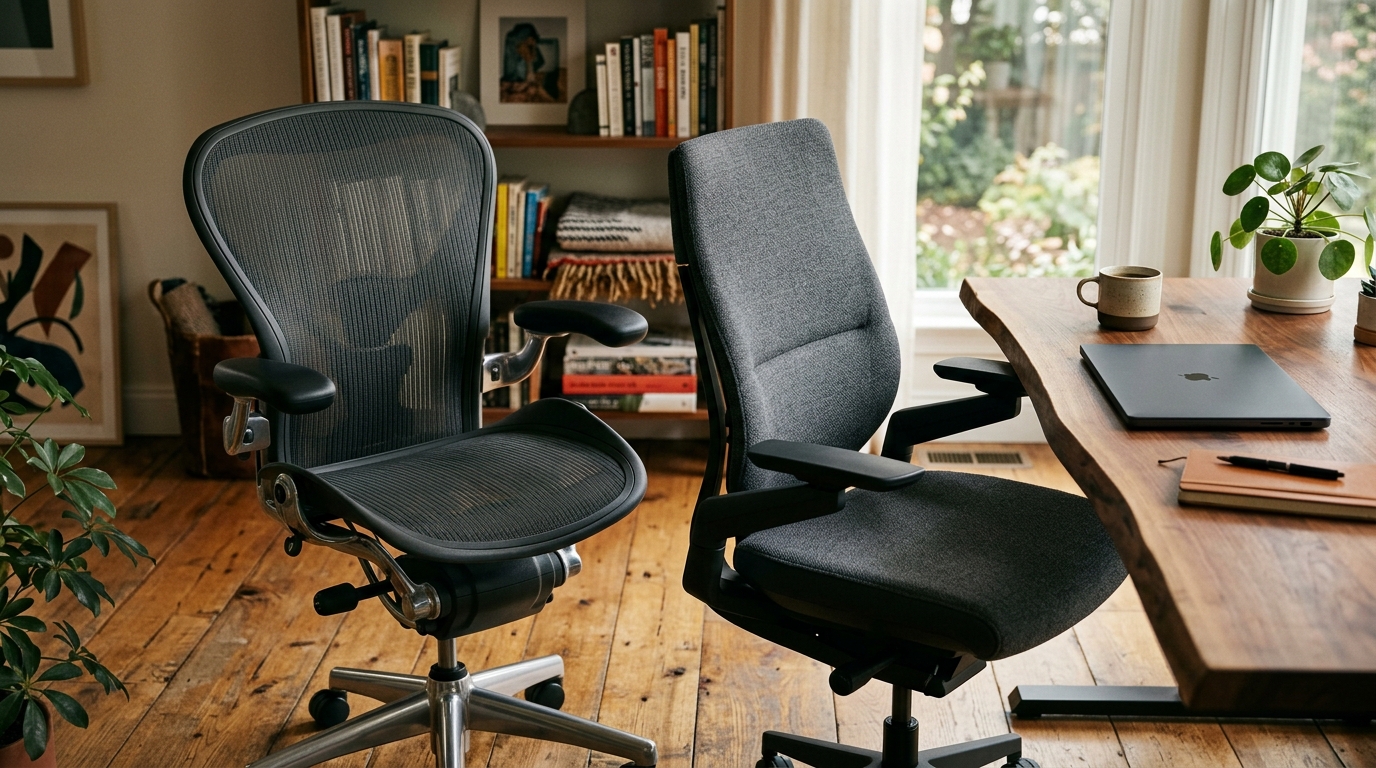
For most people, mesh wins. Mesh chairs breathe better, hold their lumbar support for 8-12 years, and suit long sessions in average to warm rooms. Padded foam chairs run warmer and lose cushion over 3-5 years, but they suit cold home offices and users who prefer softer initial cushioning for sessions under 4 hours.
Mesh vs padded chair: key differences at a glance
| Product | Best for | Rating | Notes | |
|---|---|---|---|---|
| Breathability and heat buildup | Mesh | ★★★★★ | Mesh allows continuous airflow through the back and seat. Foam and fabric trap body heat. In a 70°F room, mesh back panels stay 3-5°F cooler than foam after 2+ hours of sitting. | — |
| Lumbar support durability | Mesh | ★★★★☆ | High-quality mesh (Herman Miller, Steelcase) holds its tension for 8-12 years. Foam cushions compress permanently over 3-5 years and lose the ability to support the lumbar curve without a separate insert. | — |
| Initial cushioning comfort | Foam/padded | ★★★★☆ | Foam provides softer immediate contact, especially noticeable for users with prominent sit bones. Mesh feels firmer at first and takes 1-2 weeks to feel natural for users switching from padded chairs. | — |
| Cold office performance | Foam/padded | ★★★★☆ | Mesh chairs feel cold against the back and thighs in offices kept below 65°F. Padded fabric retains warmth and feels more comfortable in cold environments throughout the workday. | — |
| Lifespan of support material | Mesh | ★★★★★ | Premium mesh holds structural integrity for a decade-plus with no maintenance. Foam cushions require replacement or a lumbar insert after 3-5 years to maintain ergonomic function. | — |
| Ease of cleaning | Mesh | ★★★★☆ | Mesh wipes clean with a damp cloth; spills pass through rather than soaking in. Padded fabric absorbs liquids and requires deeper cleaning. Leather and vinyl padded options are an exception. | — |
| Price for equivalent ergonomics | Foam/padded | ★★★☆☆ | A very good padded ergonomic chair costs $300-500. The best mesh chairs (Aeron, Leap) start at $800-1,000 new; budget mesh options under $400 often use inferior tension systems that sag quickly. | — |
Why mesh chairs hold their shape longer
The durability advantage of mesh comes from the nature of the material under load. When you sit in a foam chair, the foam compresses — permanently, over thousands of cycles. A seat cushion that felt supportive in year one typically delivers 30-40% less resistance by year four. Users compensate by adding lumbar pillows, tilting forward, or sitting on the edge of the seat, all of which introduce posture problems.
Premium mesh — specifically the 8Z Pellicle used in Herman Miller Aerons and the LiveBack mesh used in Steelcase Leap chairs — uses tensioned polymer strands that deflect under load and return to their original position. The elastic memory is built into the molecular structure of the mesh, not into a foam pad that fatigues. Herman Miller warrants the Aeron’s mesh for 12 years. That is not marketing language — mesh genuinely retains its support profile through extended use in a way that foam cannot match.
Budget mesh chairs are the exception to this rule. Inexpensive mesh backs use lower-density plastic mesh that sags within 2-3 years, often worse than mid-grade foam. The durability advantage belongs to premium mesh specifically, not to mesh as a category.
Why padded chairs suit cold environments and some body types
Heat breathability cuts both ways. In an air-conditioned office kept at 64-68°F, a mesh back and seat feel noticeably cold — especially during the first 20-30 minutes of sitting. This is a real comfort issue that some users find consistently distracting throughout the workday, not just at startup.
Padded fabric and padded leather chairs retain warmth, which in cold environments translates to more comfortable sustained sitting. If your home office runs cold in winter, a padded chair will feel meaningfully better from October through March.
The other scenario where padded chairs have a genuine edge: users with very little body padding. People with low body fat and prominent ischial tuberosities (sit bones) often find mesh seats feel hard and create pressure point discomfort during long sessions. A well-cushioned seat — particularly one with a contoured foam base like the Steelcase Leap — distributes sit-bone pressure more comfortably than mesh alone.
Who should buy a mesh chair
A mesh chair makes the most sense if you:
- Work 6 or more hours per day at a desk
- Sit in a room kept at 68°F or warmer year-round
- Have experienced back pain from chairs that lost lumbar support over time
- Want a chair you can use for a decade without ergonomic degradation
- Tend to feel hot while working or find yourself sweating against your chair back
Who should buy a padded chair
A padded chair makes the most sense if you:
- Work in a cold office (below 66°F consistently) and find mesh uncomfortable
- Sit 4 hours or fewer per day and prioritize immediate cushioning feel
- Have prominent sit bones and find firm mesh seats create pressure points
- Are buying a conference room or guest chair with lighter daily use
- Want to spend $300-600 for very good ergonomic support and acceptable durability
Top mesh chair picks
Best for Best overall mesh chair
Herman Miller Aeron Chair
The Aeron is the benchmark against which every other mesh chair is measured. The 8Z Pellicle mesh uses eight zones of varying tension to support different body regions — firmer under the sit bones, softer across the lumbar. Three size variants (A, B, C) ensure the geometry fits short, average, and tall frames. PostureFit SL lumbar supports both the sacrum and lumbar curve simultaneously. Comes with a 12-year warranty on all parts and labor.
★★★★★ 5.0
Check current price on Amazon→Pros
- Eight-zone mesh tension system supports different body regions with appropriate firmness
- Three size options (A/B/C) mean the chair fits your specific frame geometry rather than one-size-fits-all
- PostureFit SL sacral-lumbar support is the most sophisticated standard lumbar system available
- 12-year comprehensive warranty — genuine decade-plus lifespan with no cushion degradation
- Fully adjustable: arm height/width/depth/pivot, seat depth, forward tilt, and tilt tension
Cons
- New price of $1,400-1,800 is a significant investment; certified refurbished units start around $500-700
- Size A fits users under 5ft 4in, Size C fits users over 6ft 2in — ordering the wrong size is a common mistake
- Mesh feel takes 1-2 weeks to feel natural for users switching from padded chairs
Best for Best mesh chair under $500
Branch Ergonomic Chair
The Branch Ergonomic Chair is the best-performing mesh chair under $500 in repeated independent ergonomic assessments. It uses a woven mesh back with adjustable lumbar support, 3D armrests, and a seat depth slider — features most chairs at this price omit. Build quality is noticeably better than most Amazon-native competitors: the base and mechanism stay solid through years of regular use. A strong option for users who want mesh ergonomics without the premium price tag.
★★★★☆ 4.0
Check current price on Amazon→Pros
- Woven mesh back with independently adjustable lumbar support — rare under $500
- 3D armrests adjust height, width, depth, and pivot; comparable to chairs costing twice as much
- Seat depth slider accommodates users from 5ft 2in to 6ft 3in
- Solid base and mechanism; does not develop wobble or squeaks within the first 2-3 years of daily use
Cons
- Mesh tension is fixed — cannot be adjusted for lighter or heavier users the way premium chairs can
- Maximum seat height of 19.5 inches is low for users over 6ft 2in; taller users should size up
- Sold primarily through the Branch website; Amazon stock varies by color and configuration
Top padded chair picks
Best for Best overall padded ergonomic chair
Steelcase Leap V2
The Steelcase Leap V2 uses a contoured foam-and-fabric seat with a LiveBack backrest that flexes to follow the natural curve of your spine as you shift posture throughout the day. The seat cushion uses high-density foam with a graduated edge that does not cut off leg circulation. The Natural Glide System lets the seat slide forward as you recline, keeping hip angle consistent. Available in fabric and leather upholstery. Backed by a 12-year warranty.
★★★★★ 5.0
Check current price on Amazon→Pros
- LiveBack system flexes with spine movement instead of holding a fixed position — best dynamic support in its category
- Natural Glide System maintains hip angle during recline, eliminating the lumbar strain most chairs cause when tilted back
- High-density foam seat with graduated edge distributes sit-bone pressure better than flat foam alternatives
- 12-year warranty with parts widely available; chairs from 2012 are still being serviced and resold
- Wide range of fabric colors and leather upholstery options for home office aesthetics
Cons
- New price of $1,400-1,600; certified refurbished units from Steelcase dealers start at $400-600
- Backrest height adjustment range is narrower than the Aeron — users over 6ft 3in may find the upper back area uncomfortable
- Does not breathe as well as mesh — expect warm back contact after 2+ hours in a room above 70°F
What to skip
Budget mesh chairs under $150 are the worst of both worlds: they use low-density plastic mesh that sags in 1-2 years and provides minimal lumbar support from day one. The breathability benefit is real, but sagging mesh actively pushes the spine into a rounded position rather than supporting its natural curve. You end up with the discomfort of a hard surface and none of the ergonomic benefit.
High-back gaming chairs — whether mesh or faux-leather — use oversized bucket seat designs that do not match standard desk ergonomics. The side bolsters that look supportive actually interfere with elbow and shoulder positioning at a desk. Racing-inspired recline angles work for watching content on a large screen, not for 8-hour workdays at a keyboard.
Chairs with fixed lumbar bumps (common in $200-400 padded chairs) position the lumbar support at one height. This fits roughly half of users well and creates lumbar strain for everyone else. Any ergonomic chair worth buying has a height-adjustable or flexible lumbar system.
FAQ
Frequently asked questions
Is a mesh chair better for back pain?
How long does a mesh office chair last?
Are mesh chairs better for hot weather?
Can mesh chairs be used in cold offices?
What is the best budget mesh office chair?
Is the Herman Miller Aeron worth the price?
Bottom line
For most people who work long hours at a desk, a quality mesh chair is the better long-term investment. The breathability advantage is real in rooms above 68°F, and the durability of premium mesh over 8-12 years versus foam that needs replacement support after 3-5 years makes the higher initial cost easier to justify over a decade of use.
The Herman Miller Aeron is the benchmark mesh chair — buy it new if budget allows, certified refurbished if not. The Branch Ergonomic Chair is the best option for users who want mesh performance without the premium price. On the padded side, the Steelcase Leap V2 is the gold standard, particularly for users who prefer a more traditional cushioned feel or work in consistently cold environments.
The material matters, but it is not the whole story. A well-designed padded chair with an adjustable lumbar system will serve you better than a cheap mesh chair every time. Prioritize full adjustability, lumbar support quality, and seat depth range regardless of which material you choose.
For chair-specific setup guidance, see how to adjust your office chair. For back pain relief strategies that work with any chair, see how to fix back pain at your desk. For a full comparison across more options, see best office chairs for back pain and best ergonomic chairs.