roundups
Best Balance Boards for Standing Desks of 2026
Best balance boards for standing desks in 2026: wobble, rocker, and terrain picks that fight fatigue and keep you moving during long work sessions.
 Daniel Osei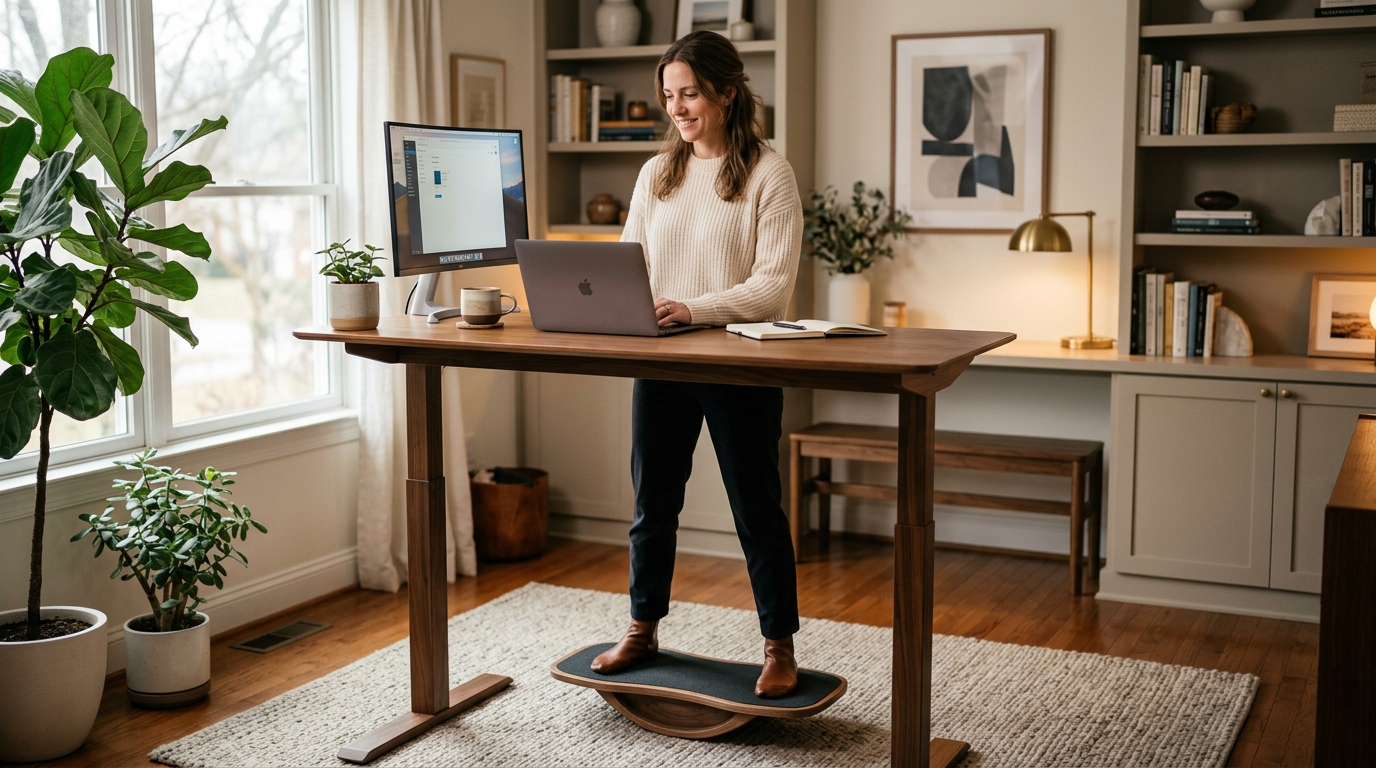
Standing at your desk all day is not the same as standing actively. The research on prolonged static standing is less flattering than the sit-stand desk industry implies: standing in one position with locked joints for hours creates its own set of fatigue problems — lower back compression, hip flexor tightness, and calf pump fatigue that can be worse than sitting. The fix is movement, not just standing. A balance board forces micro-adjustments — small, continuous shifts in weight distribution — that engage your lower leg musculature, recruit your core stabilizers, and prevent the static lockout that turns “standing” into a different kind of grind.
Balance boards designed for standing desk use range from simple wobble boards (a flat deck on a dome-shaped bottom) to terrain anti-fatigue mats with ridges and edges to step on. Price range is similarly wide: $25 for a basic wobble board to $150 for a premium fluid-motion board made from recycled composite. The picks below cover the full range and prioritize boards that are actually usable for 2–6 hour standing sessions rather than 10-minute workout drills.
How we picked
A balance board earns a place in an ergonomic office setup only if it meets a different bar than a gym balance board. We weighted these criteria:
-
Deck size. Gym balance boards are typically 12–13 inches in diameter — functional for short workout sessions where you plant your feet deliberately. For 2–4 hours of office standing, you need at least 15–17 inches of deck width so natural weight shifts don’t constantly bring you to the edge. The best office-specific balance boards run 17–25 inches wide.
-
Range of motion. Boards with too much tilt angle (more than 15°) demand active athletic attention; you’re working out, not working. Office-use boards typically offer 10–12° of tilt — enough to engage stabilizers without requiring conscious effort to stay upright. The Fluidstance Level is the benchmark here: it’s designed to produce fluid, minimal-effort sway rather than balance challenges.
-
Non-slip performance. The top surface needs grip under socked feet — the typical office standing surface. Rubber, EVA foam, or textured surfaces all work. The bottom needs grip on both hardwood and carpet. Any board that slides laterally under body weight is unusable and unsafe.
-
Fatigue profile. A board that fatigues your ankles in 30 minutes doesn’t help you stand for 3 hours. We prioritized boards with graduated motion — enough instability to keep muscles engaged, not enough to demand athletic compensation.
-
Build quality. Wobble boards take a surprising amount of repeated mechanical stress. Boards with thin MDF decks or injection-molded plastic domes show wear within a year of daily use. Solid wood, thick bamboo, and composite construction last significantly longer.
Quick comparison
| Product | Best for | Rating | Notes | |
|---|---|---|---|---|
| Fezibo Standing Desk Balance Board | best overall — office-specific design, wide deck, anti-fatigue foam core | ★★★★★ | $45–65. 25.6" × 14.6" deck. EVA foam surface. Rubber non-slip bottom. | Check price |
| Fluidstance Level | best premium — fluid ball-and-socket motion, recycled composite deck | ★★★★☆ | $130–150. 27" × 14" deck. Continuous 360° fluid motion. GreenGuard certified. | Check price |
| Topo Comfort Mat by Ergodriven | best terrain mat — passive micro-movement, better for all-day sessions | ★★★★★ | $80–100. Raised terrain surface (not a board). Best for 4–6 hour standing. | Check price |
| Yes4All Wooden Wobble Balance Board | best budget — solid wood, 360° tilt, under $35 | ★★★★☆ | $25–35. 15.7" round deck. 10° tilt. 300 lb capacity. Simple and durable. | Check price |
| Gaiam Evolve Balance Board | best for beginners — anti-burst dome, wider platform, gentle wobble | ★★★★☆ | $55–75. 17" wide platform. Anti-fatigue foam surface. Lower wobble intensity. | Check price |
| Generic sub-$20 compact boards | skip — deck too small, tilt too aggressive for office use | ★★★☆☆ | Fitness-oriented sizing and geometry; not suited for 2–4 hour standing sessions. | Check price |
The picks
Best overall: Fezibo Standing Desk Balance Board
Best for office workers who want an office-specific balance board with a wide deck, anti-fatigue foam surface, and reliable non-slip performance under socked feet
Fezibo Standing Desk Balance Board
Fezibo makes standing desks and standing desk accessories, so the balance board they designed actually addresses standing desk use rather than athletic training. The 25.6 × 14.6-inch deck is wide enough to comfortably accommodate natural standing-width foot positions without constant edge awareness. The deck surface is EVA anti-fatigue foam with a textured grip pattern — cushioned enough to soften floor pressure on long sessions, textured enough to grip socked feet without slipping. The rocker mechanism underneath gives smooth front-to-back and lateral micro-sway with enough resistance to keep you engaged without demanding active balance correction. At $45–65, it's the first pick for anyone setting up a standing desk workspace who hasn't tried a balance board before.
★★★★★ 4.6 · 6,200 reviews
Check current price on Amazon→Pros
- 25.6" × 14.6" deck is wide enough for natural standing-width foot positioning
- EVA foam anti-fatigue surface cushions foot and joint pressure during long sessions
- Textured grip surface prevents foot slippage in socks — critical for office use
- Rocker mechanism calibrated for office use: smooth micro-sway, not athletic challenge
- Rubber bottom pad grips hardwood and low-pile carpet without sliding
- Low profile (under 3" tall) fits comfortably under standard desk depth
Cons
- Front-to-back rocking is smoother than lateral sway — the board has a preferred axis
- EVA foam surface shows compression wear over 12–18 months of daily use
- Motion is constrained to the rocker geometry, not true 360° wobble
- Heavier than round wobble boards — less convenient to move when switching to seated work
Best premium: Fluidstance Level
Best for users who want the smoothest, most natural-feeling standing motion and are willing to pay a premium for it
Fluidstance Level Standing Desk Balance Board
Fluidstance designed the Level from the ground up for standing desk work, not gym training. The ball-and-socket mechanism produces genuinely fluid 360° motion with a natural resistance curve — you can sway, rock, and rotate without the snap-back of a dome-style wobble board or the constrained axis of a rocker board. The 27 × 14-inch deck is made from recycled composite (GreenGuard certified for indoor air quality), with a cork-grain textured surface for grip. The motion range is subtle: you're not dramatically tilting, you're making small, almost unconscious shifts that keep your legs cycling through micro-contractions over hours. For users with existing lower back issues who want active standing without strain, the Level's gentle motion profile is the pick.
★★★★☆ 4.4 · 2,100 reviews
Check current price on Amazon→Pros
- Ball-and-socket design produces the smoothest 360° fluid motion of any office balance board
- 27" × 14" deck fits two-foot stance widths without edge crowding
- Recycled composite construction with GreenGuard indoor air quality certification
- Cork-grain textured surface grips socked and bare feet equally well
- Gentle tilt range (8–10°) maintains posture without active compensation
- Designed specifically for office standing — not a repurposed gym product
Cons
- $130–150 is the highest price in the category — 2–3× more than the Fezibo
- No anti-fatigue foam cushioning — harder surface than EVA alternatives
- Fluid motion requires a few days of adaptation if you're coming from a static standing mat
- Availability can vary; order lead time sometimes runs 5–10 business days
Best terrain mat: Topo Comfort Mat by Ergodriven
Best for users who want all-day standing comfort with micro-movement variety, without the active balance challenge of a wobble or rocker board
Topo Comfort Mat by Ergodriven
The Topo is not technically a balance board — it's an anti-fatigue mat with a topographic terrain surface: a raised central ridge, angled side slopes, and a slightly elevated forward edge that your feet naturally explore while standing. The result is continuous, intuitive postural variation without any deliberate balance work. Most office users find the Topo more sustainable for 4–6 hour standing sessions than a wobble board, because the terrain prompts movement rather than demanding it. The $80–100 price is higher than basic anti-fatigue mats, and it's the right premium to pay if you find active balance boards fatiguing but still want more than a flat foam rectangle. Key limitation: the terrain doesn't provide the active muscle engagement of a real balance board, so if your goal is core or lower-leg activation, a wobble board is still the right tool.
★★★★★ 4.5 · 11,400 reviews
Check current price on Amazon→Pros
- Terrain surface prompts continuous natural micro-movement without active balance demand
- Polyurethane foam holds up under daily use without the compression wear of EVA
- More sustainable than a wobble board for 4–6 hour standing sessions
- Easy to step on and off — no tilt angle to adapt to, just stand and move naturally
- 26" × 29" footprint fits comfortably in front of standard standing desks
- Consistently one of the highest-reviewed anti-fatigue products in the office category
Cons
- Not a balance board — no active balance challenge, less lower-leg and core engagement than a wobble board
- Large 26" × 29" footprint compared to compact circular wobble boards
- Heavy (9 lbs) and slightly awkward to store when the desk is lowered for sitting
- Terrain edges can feel firm through thin socks — better experienced in bare feet or cushioned soles
Best budget: Yes4All Wooden Wobble Balance Board
Best for users who want a real 360° wobble board in solid wood construction under $35 to test balance board standing before committing to a pricier option
Yes4All Wooden Wobble Balance Board
Yes4All's wooden wobble board is the best budget option because it's made from real solid wood rather than particle board or MDF, has a 300 lb weight capacity, and provides genuine 360° tilt with a 10° range that's appropriate for office standing — not so aggressive that you need athletic attention, enough to keep muscles engaged. The 15.7-inch circular deck is smaller than the Fezibo's rectangular deck, which means you're more conscious of the edges during casual weight shifts and will need a week or so to adapt. For the price, the build quality is significantly better than plastic dome boards or thin wood substitutes in the same range. This is the right starting point if you want to test whether balance board standing works for your body before investing $80–150.
★★★★☆ 4.3 · 14,500 reviews
Check current price on Amazon→Pros
- Solid wood construction holds up to daily use better than MDF or injection-molded plastic
- 300 lb weight capacity — rated for real-world use
- 360° tilt with 10° range hits the right office-use balance challenge level
- Under $35 — the lowest cost for a genuinely functional balance board
- Simple single-piece design with no moving parts to wear out over time
Cons
- 15.7" circular deck is smaller than office-specific rectangular boards — more edge awareness
- No anti-fatigue foam cushioning — harder on feet during long sessions
- Circular shape doesn't match the natural two-foot rectangular standing stance as intuitively as rectangular boards
- Some batches lack non-slip tape on the top surface — verify it's included or add grip tape yourself
Best for beginners: Gaiam Evolve Balance Board
Best for first-time balance board users who want a lower-challenge wobble dome with anti-fatigue foam surface and a wider platform than standard compact round boards
Gaiam Evolve Balance Board
The Gaiam Evolve takes the classic wobble board design and applies office-specific modifications: a 17-inch wide rectangular platform (wider than most round beginner boards), an EVA foam top surface for cushioning, and a low-profile dome that keeps tilt angle gentle. The anti-burst dome insert is the key differentiator from cheap wobble boards — it deflates gradually under failure rather than popping suddenly, which matters for office safety during unattended sessions. At $55–75, it's more expensive than the Yes4All but adds a wider platform, softer surface, and that safety feature. The right pick for users who tried a compact round wobble board and found it too fatiguing or edge-limited for sustained office use.
★★★★☆ 4.2 · 3,800 reviews
Check current price on Amazon→Pros
- 17" wide rectangular platform handles natural two-foot standing stance better than round boards
- EVA foam surface cushions foot pressure during longer sessions
- Anti-burst dome deflates gradually rather than popping — meaningful safety feature
- Lower wobble intensity than the Yes4All — better for users sensitive to aggressive instability
- Widely available from Gaiam and Amazon with consistent quality control
Cons
- $55–75 is more expensive than the Yes4All for less motion range and a smaller deck than the Fezibo
- Anti-burst dome loses tension gradually over 6–12 months of use
- EVA foam surface wears faster than hard wood or composite decks
- Motion is constrained to the dome axis — less fluid than the Fluidstance Level
What to skip
Generic sub-$20 plastic dome boards from no-name brands. These share one fatal flaw: the dome is sized for compact fitness use, not for a natural two-foot standing stance. The deck is typically 12–13 inches — large enough to step on with both feet only if you stand abnormally narrow. Combined with cheap plastic that creaks under load and a dome that either feels rigid or collapses, these are a waste. The Yes4All at $25–35 is the true entry point for a functional balance board.
Roller-style balance boards (flat deck + cylindrical roller). These are aggressive dynamic training tools that require constant active attention and have unlimited tilt range in one axis — they’re one of the leading causes of balance board-related office injuries. Excellent for 10-minute workout drills. For 2–4 hours of standing while working, they’re counterproductive: you’ll be managing the board instead of working.
Standing desk mats labeled as “balance boards.” Some flat or minimally textured anti-fatigue mats are marketed with “balance” language because the term is commercially popular. A flat 1-inch foam pad is not a balance board. Look for an actual instability mechanism — a dome, rocker, terrain surface, or fluid pivot — before treating it as one. The Topo Comfort Mat makes the cut because it genuinely creates postural variation; a flat foam mat with “ergonomic” written on the packaging does not.
FAQ
Frequently asked questions
Do balance boards actually help with standing desk fatigue?
How long should I stand on a balance board per session?
Will a balance board work on carpet?
Balance board vs anti-fatigue mat — which should I start with?
Can I type normally while standing on a balance board?
What goes under a balance board on hardwood floors?
Bottom line
Best overall: Fezibo Standing Desk Balance Board at $45–65 for the widest office-viable deck, cushioned EVA surface, and motion profile calibrated for work-session standing. Best premium: Fluidstance Level at $130–150 for the smoothest fluid motion and the most natural-feeling standing experience. Best terrain option: Topo Comfort Mat by Ergodriven at $80–100 for all-day passive standing comfort without active balance demand. Best budget: Yes4All Wooden Wobble Board at $25–35 to test whether balance board standing works for you before committing more.
Skip any board under 15 inches wide, any roller board for office use, and anything marketed as a balance board that doesn’t actually have an instability mechanism.
Complete the standing setup: anti-fatigue mats for passive standing comfort, standing desks if you’re still on a fixed-height desk, standing desk converters to add sit-stand capability to your existing setup, or the full ergonomic office setup guide.