roundups
Best Anti-Fatigue Standing Desk Mats 2026 (Topo, Sky Mat, Imprint)
Anti-fatigue mat picks for standing desk users. Topo Comfort, Sky Mat, Imprint CumulusPRO compared on contour, density, and durability.
 Daniel Osei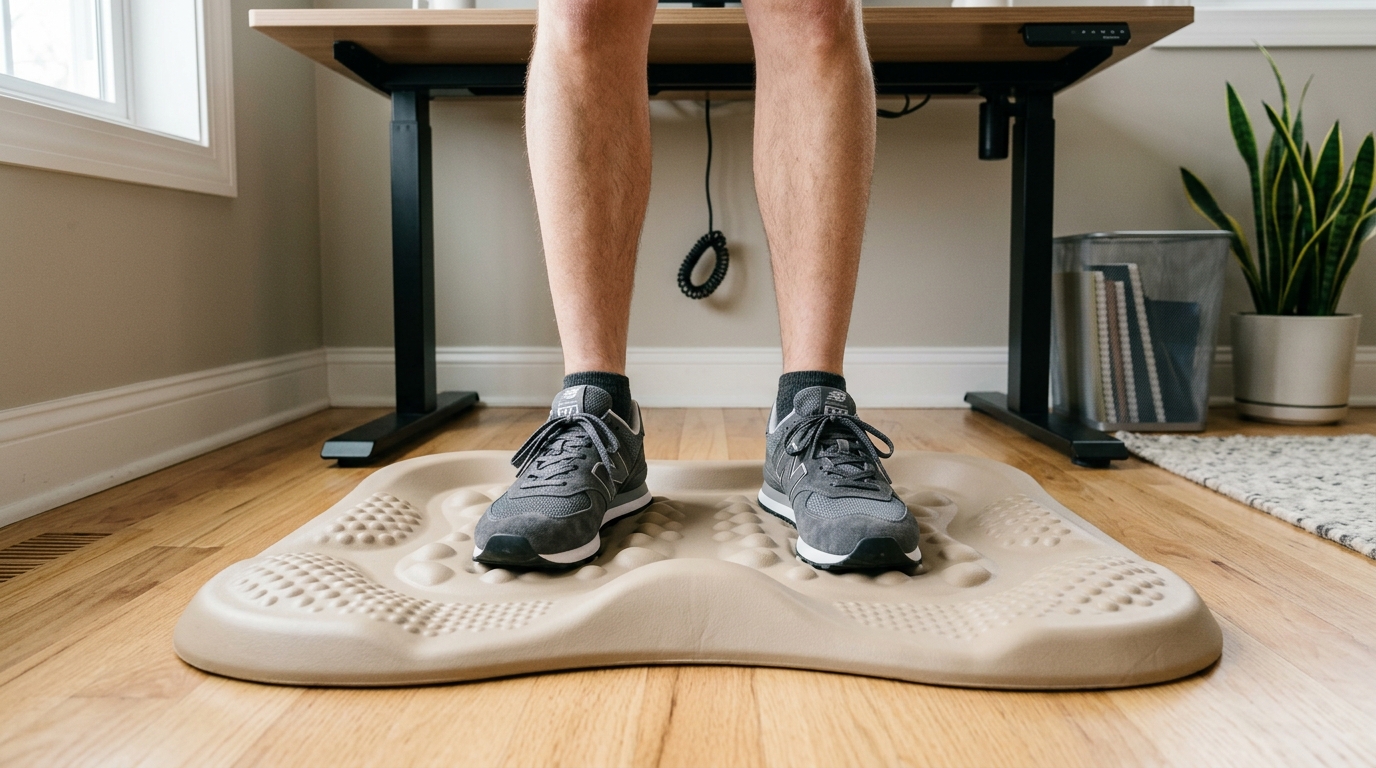
Standing all day on a hard floor is a fast path to heel pain, lower-leg fatigue, and lumbar compression — exactly the problems a standing desk was supposed to solve. The fix isn’t standing less; it’s standing on something with give. An anti-fatigue mat (the technical term is “shock-absorption mat”) cushions your feet, encourages micro-movements as you naturally shift weight, and meaningfully extends how long you can stand comfortably. A $60 mat under a $700 standing desk is the most-overlooked piece of the standing-desk kit.
How anti-fatigue mats differ
Two main categories:
- Flat foam mats: rectangular slabs of dense foam, typically 0.75-1 inch thick. Cushion underfoot, no special features. Cheap, effective.
- Contoured/textured mats: sculpted with raised relief points (hills, ridges, mounds) that encourage your feet to shift weight throughout the standing session. The micro-movements engage stabilizing muscles and prevent the “stuck in place” rigidity that flat surfaces cause.
The honest comparison: flat mats are 80% of the benefit at 50% of the cost. Contoured mats are the upgrade if you stand 3+ hours per day.
Quick comparison
| Product | Best for | Rating | Notes | |
|---|---|---|---|---|
| Topo Comfort Mat (Ergodriven) | most-recommended contoured mat | ★★★★★ | $80-100. 26x29 in. Polyurethane. Sculpted terrain. | Check price |
| Topo Mini (Ergodriven) | smaller spaces, smaller stance | ★★★★★ | $60-70. 20x22 in. Same construction as Topo Comfort. | Check price |
| Sky Mat (Sky Solutions) | best value flat mat under $50 | ★★★★★ | $30-50. 20x32 in. Thick foam, beveled edges. | Check price |
| Imprint CumulusPRO | commercial-grade flat mat | ★★★★★ | $80-120. 20x36 in. Professional kitchen-grade durability. | Check price |
| AmazonBasics Anti-Fatigue | budget tier; functional flat foam | ★★★★☆ | $25-40. 20x32 in. Generic foam mat. | Check price |
| GelPro Designer Comfort | gel-filled premium tier | ★★★★☆ | $120-180. 20x32 in. Gel + memory foam composite. | Check price |
The picks
Best overall: Topo Comfort Mat
Best for the consensus best anti-fatigue mat for serious standing-desk users
Ergodriven Topo Comfort Mat (sculpted)
The Topo Comfort Mat changed the anti-fatigue mat category when it launched. Instead of a flat slab, the mat is sculpted with raised relief points (hills, ridges, mounds) that encourage your feet to micro-shift throughout the standing session. The shifting engages stabilizing muscles, breaks up postural rigidity, and meaningfully extends how long you can stand comfortably — most owners report doubling their sustainable standing time. Polyurethane foam (not the cheaper PVC or EVA most competitors use) holds up to daily use for 3-5+ years.
★★★★★ 4.7 · 6,200 reviews
Check current price on Amazon→Pros
- Sculpted terrain encourages constant micro-movement — the entire point of the mat
- Polyurethane foam (denser, longer-lasting than PVC competitors)
- 26x29 inch size accommodates most standing stances
- Beveled edges prevent tripping when stepping off
- 7-year warranty Ergodriven actually honors
Cons
- $80-100 is roughly double the price of flat anti-fatigue mats
- Sculpted surface takes 1-2 weeks to feel natural — initially uncomfortable for users used to flat mats
- Hard to clean (vacuum or wipe; not machine-washable)
- 26x29 inch can feel cramped for wider stances; consider the Topo XL or Topo Stories Edition for more space
Best budget: Sky Mat
Best for budget tier; users who want functional standing-desk cushion under \$50
Sky Mat Anti Fatigue Comfort Mat
The Sky Mat is the value pick if you want anti-fatigue cushioning without spending Topo money. Flat foam construction at 3/4 inch thickness, beveled edges, 20x32 inch footprint. It doesn't have the micro-movement encouragement of contoured mats, but for 80% of users transitioning to standing desks, the flat cushion alone is a major upgrade from a hard floor. Holds up for 2-3 years of daily use.
★★★★★ 4.5 · 8,400 reviews
Check current price on Amazon→Best commercial-grade flat: Imprint CumulusPRO
Best for users who want commercial kitchen-grade durability in a flat mat
Imprint CumulusPRO Commercial Grade Anti-Fatigue Mat
The CumulusPRO is what commercial kitchens use — and they replace these mats every 7-10 years, not every 18 months. 0.75-inch thick polyurethane foam with a textured top surface and beveled edges. The lifespan is genuinely the differentiator: a CumulusPRO bought in 2026 will still be in service in 2033. At \$80-120 it's more expensive than the Sky Mat, but the per-year cost is dramatically lower.
★★★★★ 4.6 · 2,900 reviews
Check current price on Amazon→Best for premium feel: GelPro Designer
Best for users who want gel-filled premium cushion over foam
GelPro Designer Comfort Anti-Fatigue Floor Mat
The GelPro Designer uses a gel + memory foam composite that feels softer underfoot than pure foam mats. The sensation is closer to standing on a yoga mat than on a kitchen mat — pleasant for some users, too soft for others. Premium price (\$120-180) reflects the gel construction. Best for users who specifically want a softer feel; not better than the Topo or CumulusPRO at standard standing-desk use.
★★★★☆ 4.4 · 3,100 reviews
Check current price on Amazon→What to avoid
- Sub-$25 anti-fatigue mats. EVA or PVC foam that compresses permanently within 6 months. They flatten into useless slabs.
- Mats marketed as “gel” that are actually gel-printed foam. Real gel-filled mats feel distinctly different from foam. Cheap mats with “gel” in the name often just print a gel-pattern texture on top of regular foam.
- Mats over 1.5 inches thick. Past a certain thickness, the mat becomes unstable underfoot and you wobble. 0.75-1 inch is the sweet spot.
FAQ
Frequently asked questions
Do I really need an anti-fatigue mat?
Topo vs flat foam — which is better?
How long do anti-fatigue mats last?
Can I use a yoga mat as an anti-fatigue mat?
What size do I need?
Do I need shoes on the mat?
Bottom line
Best overall: Topo Comfort Mat (sculpted, polyurethane). Best budget: Sky Mat ($30-50 flat foam). Best commercial-grade: Imprint CumulusPRO. Skip sub-$25 mats entirely.
Use the mat barefoot or in socks for the full benefit. Pair with a standing desk, chair, and the rest of the ergonomic office setup for the complete kit.